Biopharma R&D partnerships kept their pace in Q3 2026, but the deals were worth far less in total. The number of deals rose slightly, and the typical upfront payment grew. However, fewer and smaller deals drove the drop in total value.
Partnership activity edged up 3.1% to 100 deals from 97 in Q2. Total deal value, however, fell 39.8% to $50.3B from $83.6B. Upfront payments, which include equity investments, declined far less, falling 12.5% to $3.5B from $4.0B. Payments on individual deals held up even better. The average upfront payment stayed at $94M, while the median (typical) payment rose 33.3% to $40M from $30M. Across Q2 and Q3 combined, companies signed 197 deals worth $133.9B, with $7.5B in upfront payments.
Elsewhere in life sciences, deal counts and values also moved apart. Partnerships in diagnostics and tools fell 25% to 24 deals, yet their value rose 20.0% to $15.0B. Manufacturing technology and other partnerships did the reverse, rising 50% to 12 deals while their value fell 39.8% to $11.2B. In both cases, the size of individual deals, not their number, drove the change in value.
The biggest deals fell further than the market. The $100M+ Club of top deals shrank 20% to 8 deals from 10, and its total value fell 53.1% to $16.8B from $35.8B. The average club deal also shrank to $2.1B from $3.6B. Upfront payments in the club declined less steeply, falling 41.9% to $1.8B in total and 27.4% to $228M per deal.
Every standout deal involved an early-stage drug, and obesity drew the biggest upfronts. Novo committed $300M upfront for Hengrui Pharma’s oral HRS-1596, and Genentech $190M for Hanmi Pharm’s HM-17321. QuantumCell licensed AlzeCure Pharma’s NeuroRestore platform, aimed at Parkinson’s and Alzheimer’s disease, for $12M upfront. Sentivera licensed Haisco’s inflammation drug for $40M in cash and a 17.5% equity stake. Finally, Roche licensed Simcere Zaiming’s B-cell lymphoma antibody SIM-0660 for $75M upfront, in a deal worth up to $1.5B.
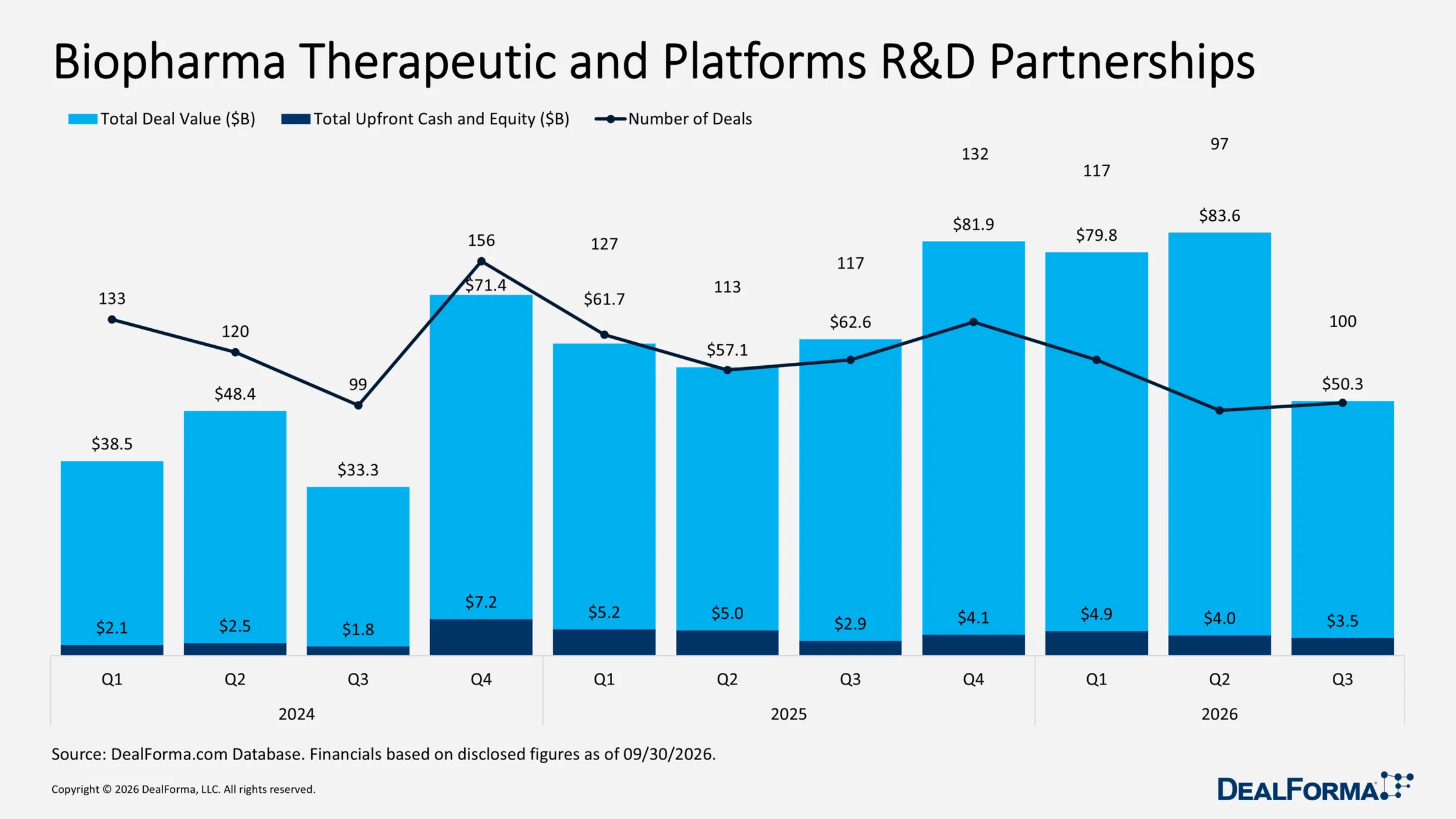
In Q3 2026, Biopharma Therapeutics and Platforms R&D Partnerships recorded 100 deals, up 3.1% from 97 in Q2. Total deal value, however, fell 39.8% to $50.3B from $83.6B. By comparison, total upfront cash and equity declined a more modest 12.5% to $3.5B from $4.0B. Per-deal upfronts proved resilient: the average was unchanged at $94M, while the median rose 33.3% to $40M from $30M. Combined, Q2 and Q3 saw 197 deals worth $133.9B, with $7.5B in total upfront cash and equity.
Biopharma Therapeutics and Platforms vs Other Life Sciences
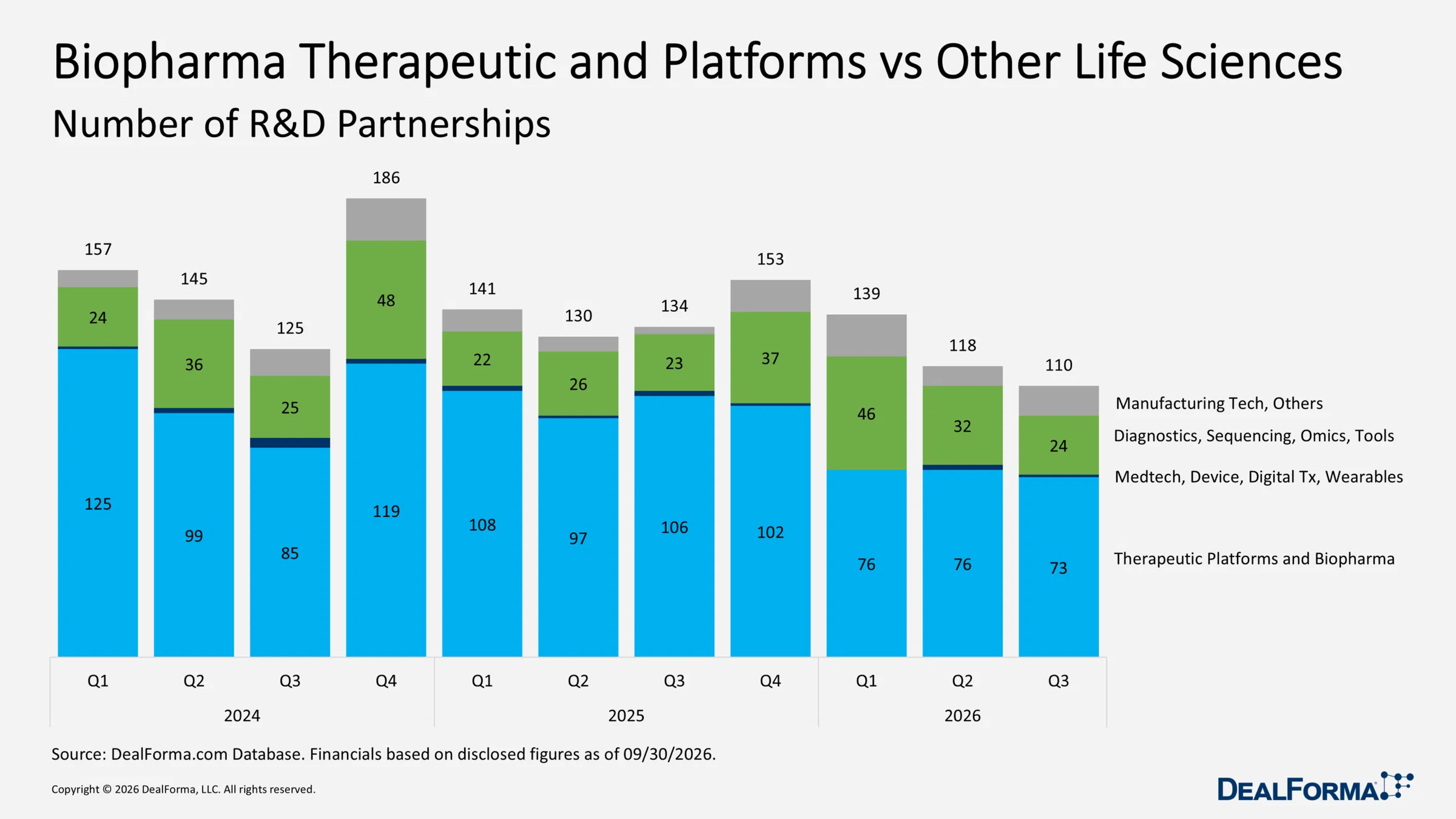
In Q3 2026, Biopharma Therapeutics and Platforms R&D Partnerships recorded 73 deals, down 3.9% from 76 in Q2. Diagnostics, Sequencing, Omics, and Tools posted the largest drop in deal count, falling 25% to 24 deals from 32. Medtech, Devices, Digital Therapeutics, and Wearables also declined 50% on a very small base, to 1 deal from 2. Only Manufacturing Technology and Other grew, rising 50% to 12 deals from 8. Overall, R&D partnerships across all subsectors fell 6.8% to 110 deals from 118. Together, Q2 and Q3 totaled 228 deals. Biopharma Therapeutics and Platforms accounted for 149, Diagnostics 56, Manufacturing Technology and Other 20, and Medtech 3.
Biopharma Therapeutic and Platforms vs Other Life Sciences
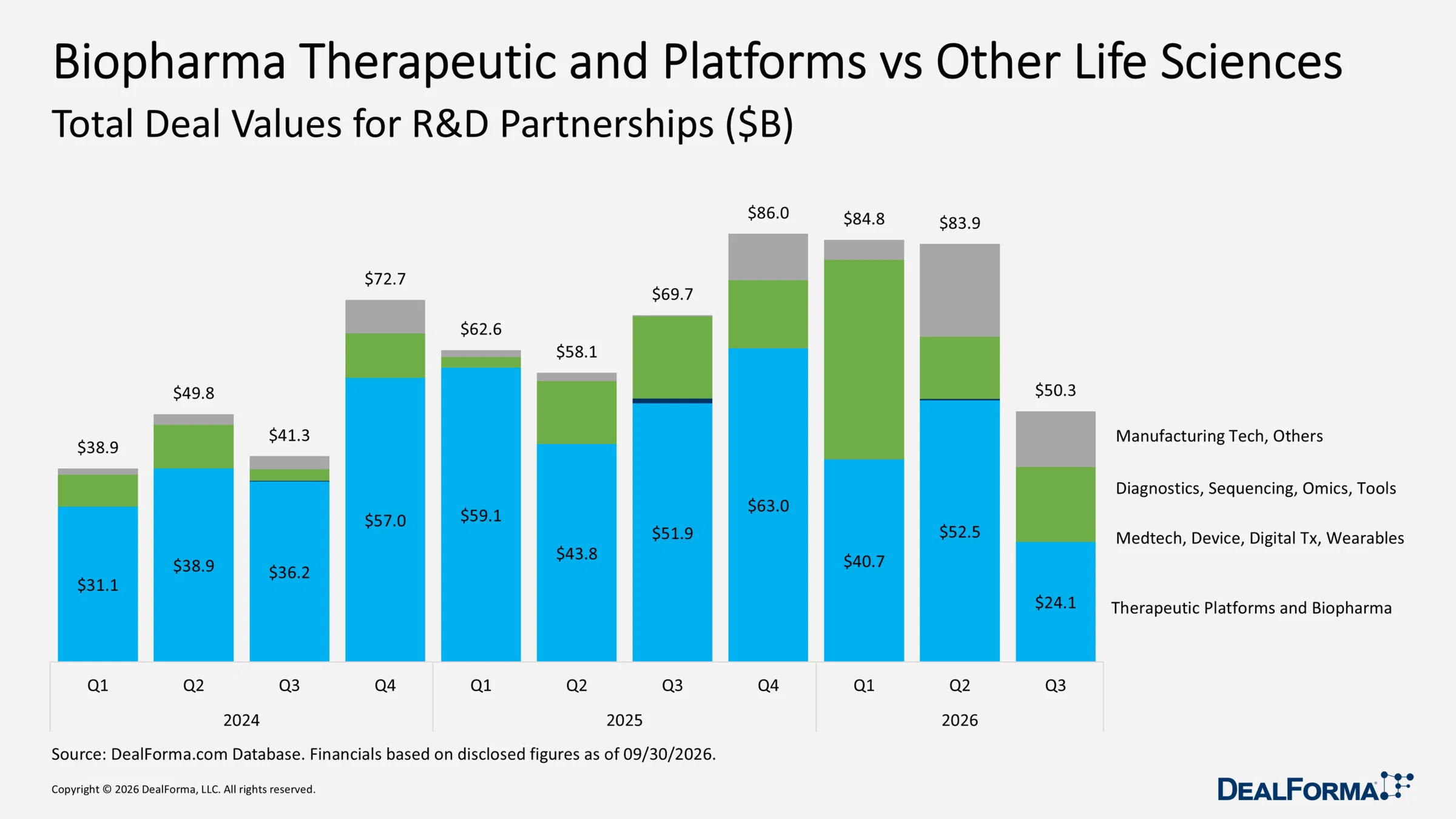
Total R&D partnership deal value across Biopharma and Other Life Sciences fell 40.0% in Q3 2026, to $50.3B from $83.9B. Biopharma Therapeutics and Platforms accounted for most of the decline, falling 54.1% to $24.1B from $52.5B. Manufacturing Technology and Other also fell 39.8% to $11.2B from $18.6B. Medtech, Devices, Digital Therapeutics, and Wearables dropped 100% to $0, from just $300M. Only Diagnostics, Sequencing, Omics, and Tools grew, rising 20.0% to $15.0B from $12.5B. Together, Q2 and Q3 totaled $134.2B in deal value. Of that, Biopharma Therapeutics and Platforms contributed $76.6B, Manufacturing Technology and Other $29.8B, Diagnostics $27.5B, and Medtech $300M.
Biopharma Therapeutic and Platforms R&D Partnerships – R&D Partnerships $100M+ Club
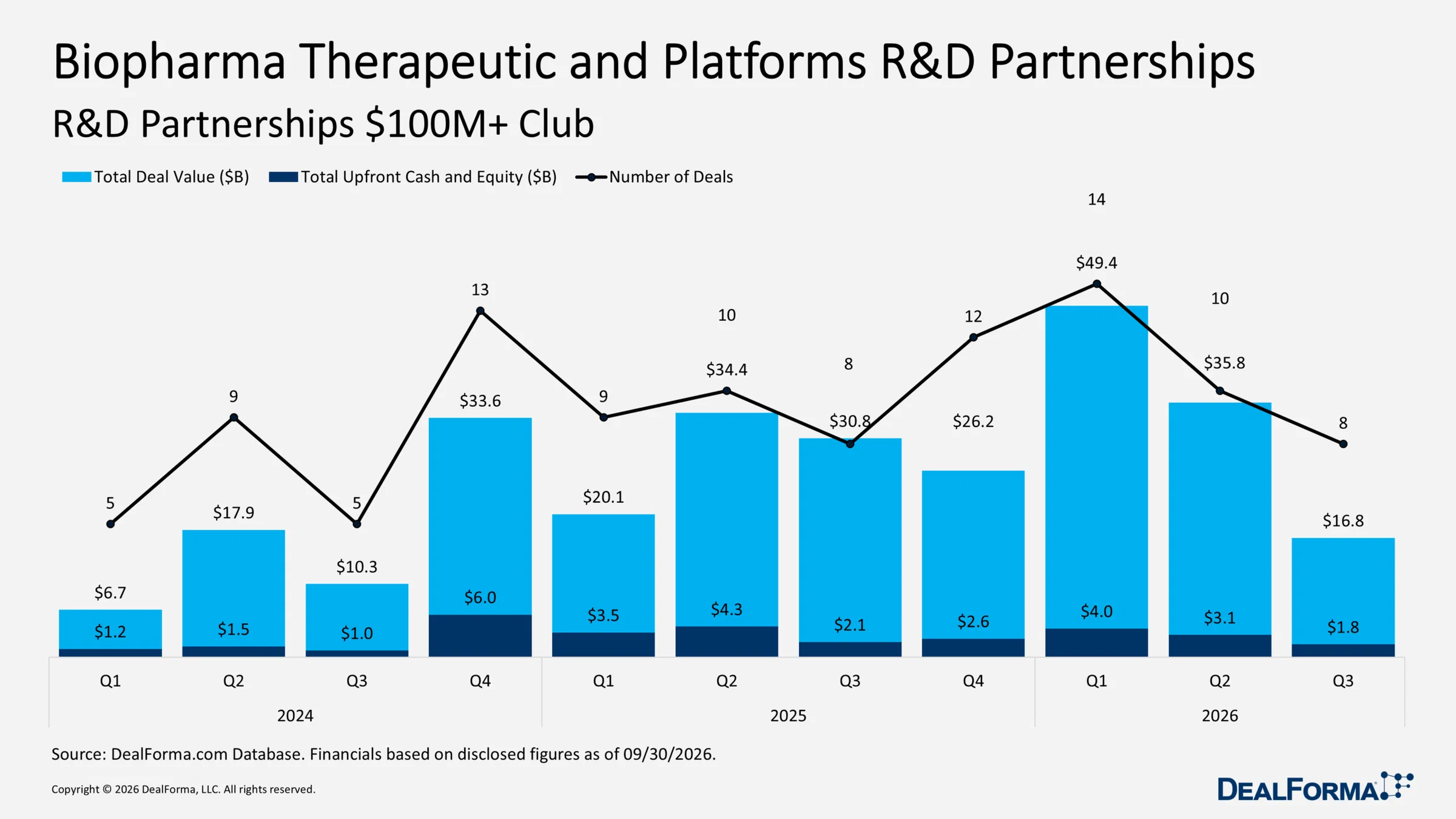
In Q3 2026, the $100M+ Club recorded 8 Biopharma Therapeutics and Platforms R&D partnerships, down 20% from 10 in Q2. Total deal value dropped 53.1% to $16.8B from $35.8B, reflecting both fewer and smaller deals. The average deal was 41.4% smaller, at $2.1B against $3.6B. Total upfront cash and equity declined less steeply, falling 41.9% to $1.8B from $3.1B. Per deal, upfronts averaged $228M, down 27.4% from $314M. Together, Q2 and Q3 accounted for 18 club deals worth $52.6B, with reported total upfront cash and equity of $5B.
Prominent Biopharma Therapeutics and Platforms R&D Partnerships in Q3 2026
Hengrui Pharma development and commercialization deal with Novo – September 2026
Hengrui Pharma granted Novo exclusive rights to HRS-1596 for $300M upfront. Hengrui is also eligible for up to $2.3B in development, regulatory, and commercial milestones (breakdown not disclosed), plus royalties. Novo’s rights to develop, manufacture, and commercialise the asset apply worldwide, excluding mainland China, Hong Kong, Macao, and Taiwan. HRS-1596 is a peptide-based GLP-1/GIP dual receptor agonist in an oral formulation designed for potential once-weekly dosing. Obesity is the primary indication, alongside type 2 diabetes, in the endocrine and metabolic therapeutic area. The asset was Phase 1-ready at signing, and Hengrui has received approval in China to begin Phase 1 clinical trials.
Hanmi Pharm development and commercialization deal with Genentech – August 2026
Hanmi Pharm granted Genentech exclusive rights to HM-17321 for $190M upfront. Hanmi is also eligible for up to $2.1B in development, regulatory, and commercial milestones (breakdown not disclosed), plus tiered royalties. Genentech’s rights to develop, manufacture, and commercialize the asset apply worldwide, excluding South Korea. HM-17321 is a peptide-based urocortin-2 analog, with obesity as the primary indication in the endocrine and metabolic therapeutic area. It is also intended for related conditions, including type 2 diabetes and cardiovascular diseases. The asset was in Phase 1 clinical development at signing. Preclinical studies have shown potential for improved weight loss, both as monotherapy and in combination with GLP-1-based therapies. Hanmi will complete the Phase 1 trial, after which Genentech will take over clinical development from Phase 2 onward.
AlzeCure Pharma development and commercialization deal with QuantumCell – July 2026
AlzeCure Pharma granted QuantumCell worldwide rights to NeuroRestore, its Alzheimer’s platform, for $12M upfront. The upfront includes a $5M equity investment at a 30% premium to the 10-trading-day average share price of SEK 3.78. AlzeCure is also eligible for “more than” $2.2B in development and commercial milestones (breakdown not disclosed). Tiered royalties range from single digits to low double digits. The rights cover development and commercialization of ACD-856, a small-molecule positive modulator of both NGF/TrkA- and BDNF/TrkB-mediated signaling (Trk-PAM). It is intended for central nervous system diseases such as Alzheimer’s and Parkinson’s disease. Parkinson’s disease is the primary indication in the neurology therapeutic area, and ACD-856 was in Phase 1 at signing.
Haisco development and commercialization deal with Sentivera – August 2026
Haisco licensed its preclinical immunology program to Sentivera, backed by Population Health Partners and ARCH Venture Partners. Sentivera gains exclusive worldwide rights to develop, manufacture, and commercialize it, excluding mainland China, Hong Kong, Macao, and Taiwan. Greater China rights stay with Haisco. Haisco will receive $40M in upfront cash plus 11,964,016 Sentivera shares, a 17.5% equity stake valued at $36M. It is also eligible for up to $1.5B in development, regulatory, and commercial milestones (breakdown not disclosed). Tiered royalties range from mid-single digits to low double digits, up to 10%, and Haisco will share in sublicensing revenue. Classified under general inflammation, the program is an oral small-molecule immunotherapy targeting type 2 inflammatory diseases. It was at the preclinical/IND stage at signing, having received China IND approval in August 2026.
Simcere Zaiming development and commercialization deal with Roche – September 2026
Simcere Zaiming granted Roche exclusive worldwide rights to develop, manufacture, and commercialize SIM-0660. Total payments could reach $1.5B, including $75M upfront and up to $1.4B in milestones (breakdown not disclosed). Simcere Zaiming will also receive tiered double-digit royalties on future net sales. SIM-0660 is a tri-specific CD79a/CD19/CD3 T-cell engager antibody. In cancer, the primary indication is B-cell lymphoma, including newly diagnosed and relapsed/refractory cases. Beyond cancer, the asset has potential applications in B-cell-mediated autoimmune diseases. It was at the preclinical/IND stage at signing.
Also check out Cancer R&D Partnerships, M&A, Venture Funding and IPO Activity – Q3 2026 Review