Large-cap biopharma M&A in H1 2026 turned narrow. One company dominated deal flow, one therapeutic area absorbed most of the capital, and a small group of names accounted for the rest. Eli Lilly set the pace while peers stayed selective, leaving the market unusually top-heavy. Large-cap buyers announced $93.8B across the half, of which $77.7B was upfront cash and equity. Targets ranged from registration-stage assets to preclinical platforms, several priced at premiums above 40%, and buyers favored bolt-on deals over megadeals even as several transactions cleared $10B.
Eli Lilly led on every measure, closing 11 deals against three each for GSK and Gilead, and topping value at $25.0B and upfront at $17.4B. Concentration ran deep: the five largest buyers took roughly $77.9B of total value (83%) and $65.7B of upfront (85%), underscoring how few companies shaped the period. Cancer drove capital allocation, drawing 12 deals worth $66.5B, or 71% of total value. Infectious disease followed at $9.0B, then autoimmune at $4.6B, inflammation at $4.2B, and neurologic disease at $3.8B. Five top transactions defined the half: AbbVie’s $10.9B purchase of Apogee in atopic dermatitis, Eli Lilly’s $7.8B acquisition of Centessa in narcolepsy, Gilead’s $8.2B buyout of Arcellx in CAR-T myeloma, GSK’s $10.6B deal for Nuvalent in lung cancer, and Merck KGaA’s $11.3B acquisition of Bio-Techne in life-sciences tools.
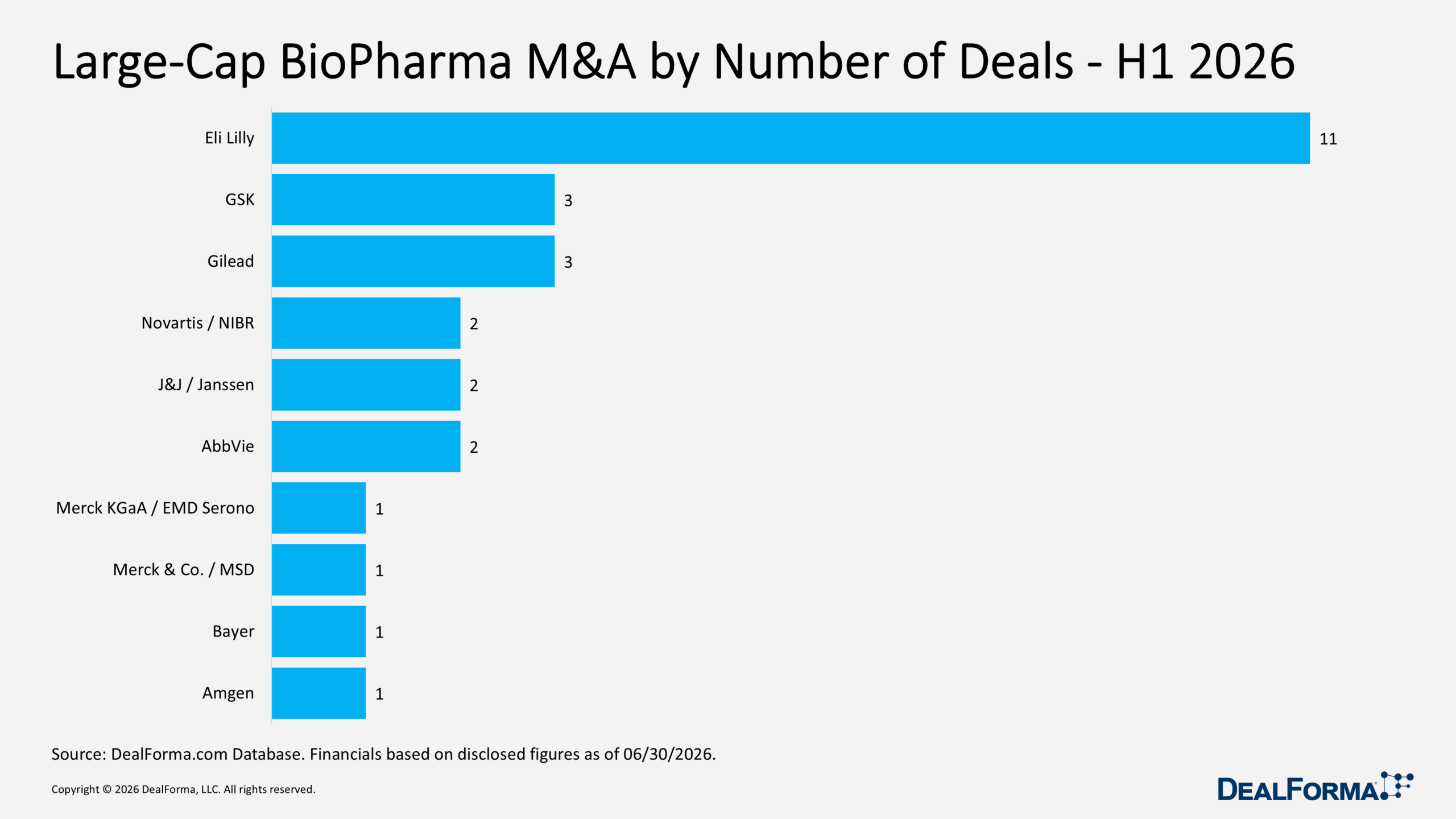
Eli Lilly was the standout acquirer among large-cap biopharma buyers in H1 2026, closing 11 M&A deals and far outpacing every peer. GSK and Gilead were the next most active with three deals each, followed by Novartis/NIBR, J&J/Janssen, and AbbVie at two apiece. Merck KGaA/EMD Serono, Merck & Co./MSD, Bayer, and Amgen each announced a single transaction. The result was a highly concentrated deal landscape: large-cap M&A in H1 of 2026 revolved around Eli Lilly, while most other major pharmaceutical companies took a more selective approach to acquisitions.
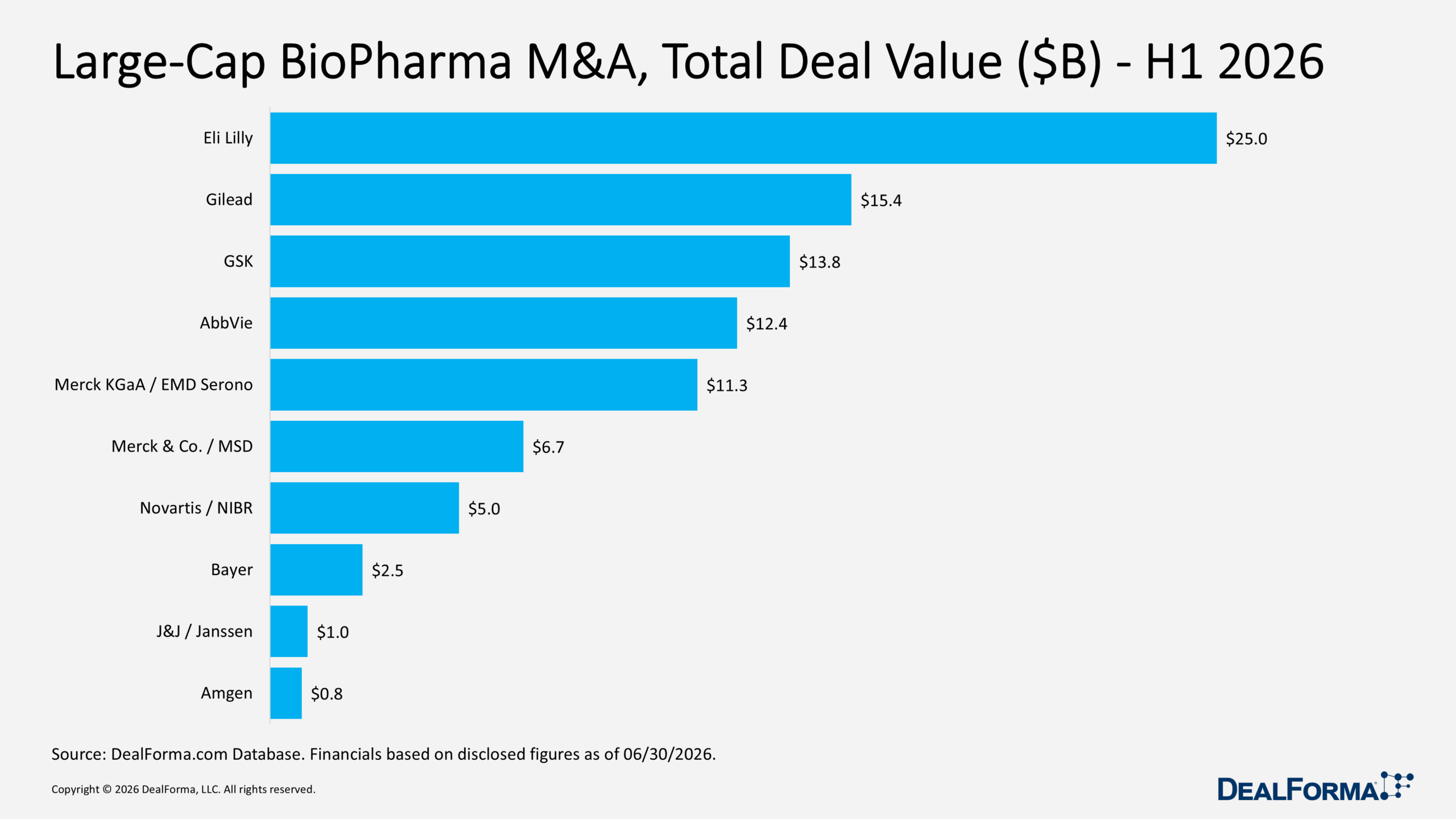
Large-cap biopharma companies announced $93.8B in total M&A deal value during H1 2026, with Eli Lilly leading the market at $25.0B. Gilead ranked second at $15.4B, ahead of GSK at $13.8B, AbbVie at $12.4B, and Merck KGaA/EMD Serono at $11.3B. Merck & Co./MSD followed at $6.7B, then Novartis/NIBR at $5.0B, Bayer at $2.5B, J&J/Janssen at $1.0B, and Amgen at $800M. Spending was heavily concentrated among the leading buyers: the top five companies accounted for roughly $77.9B, or 83% of total value.
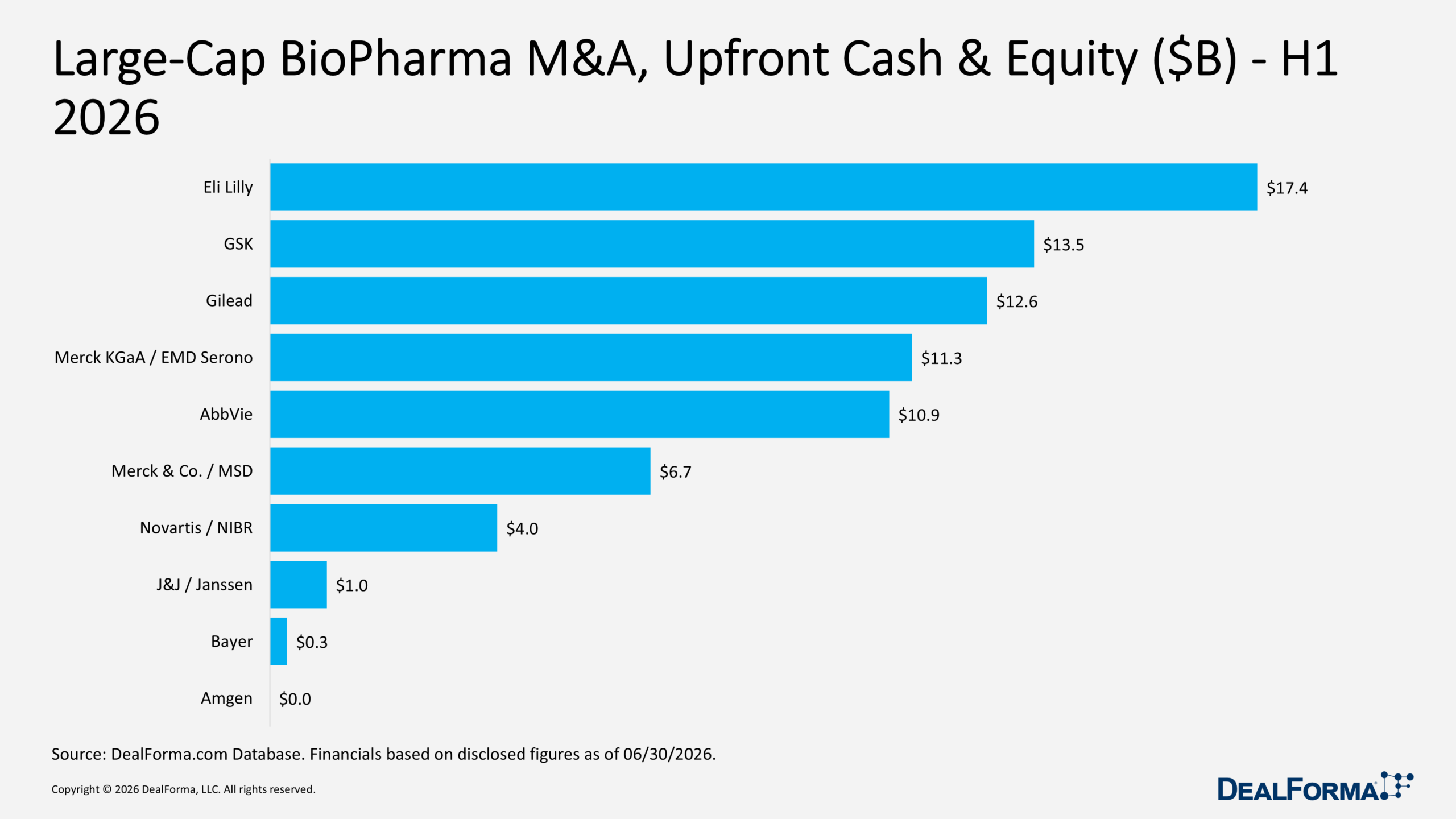
Large-cap biopharma companies committed $77.7B in upfront cash and equity for M&A during H1 2026, led by Eli Lilly at $17.4B. GSK followed at $13.5B, ahead of Gilead at $12.6B, Merck KGaA/EMD Serono at $11.3B, and AbbVie at $10.9B. Merck & Co./MSD contributed $6.7B, then Novartis/NIBR at $4.0B, J&J/Janssen at $1.0B, and Bayer at just $300M, while Amgen recorded no upfront cash or equity. Upfront spending was heavily concentrated among the top five buyers, which together accounted for $65.7B, or about 85% of the total.
Large-Cap Biopharma M&A by Therapeutic Area Focus – H1 2026
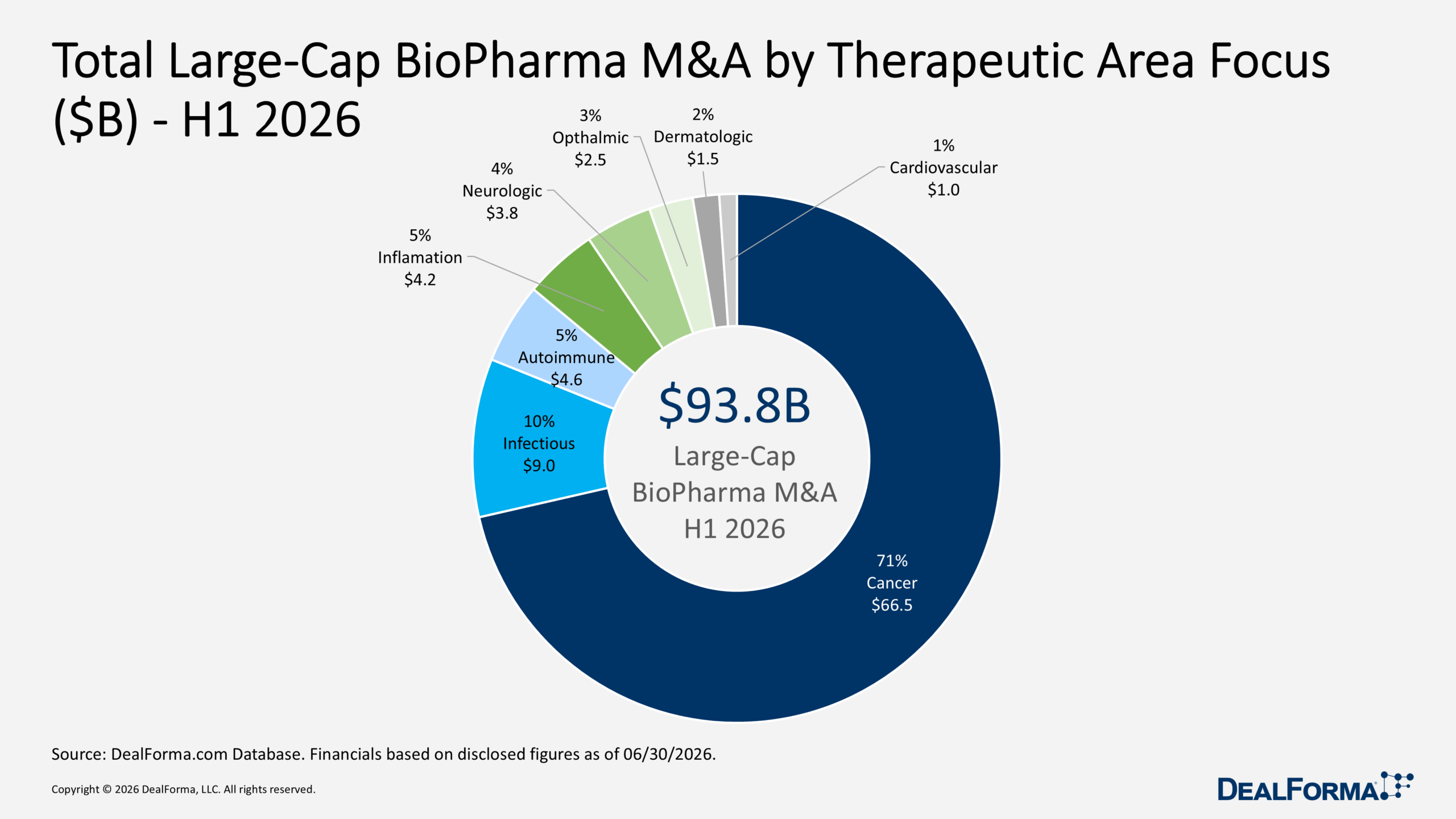
The buyer-by-therapy breakdown shows that large-cap biopharma M&A in H1 2026 was overwhelmingly driven by cancer, which accounted for 12 deals worth $66.5B, or 71% of total deal value. Cancer acquisitions were spread across most major buyers, including Eli Lilly, GSK, Gilead, Novartis/NIBR, J&J/Janssen, AbbVie, Merck KGaA/EMD Serono and Merck & Co./MSD, reflecting broad industry competition for these assets. Eli Lilly pursued the most diversified strategy, with deals spanning cancer ($9.8B), infectious diseases ($9.0B), neurologic ($3.8B), and autoimmune ($2.4B) areas, whereas several other large pharma companies concentrated on fewer therapeutic areas. Infectious disease was the second-largest category at $9.0B, followed by autoimmune at $4.6B, inflammation at $4.2B, and neurologic diseases at $3.8B. Ophthalmic deals reached $2.5B, while dermatologic and cardiovascular transactions totalled $1.5B and $1.0B, respectively. In all, 26 deals generated $93.1B in total M&A value and $79.3B in cash value.
Top Large-Cap BioPharma M&A in H1 2026
AbbVie acquired Apogee Therapeutics – June 2026
AbbVie acquired Apogee Therapeutics. Apogee’s lead asset is zumilokibart, a Phase II subcutaneous, half-life-extended monoclonal antibody targeting IL-13 for atopic dermatitis, with Phase III expected to begin in H2 2026. Zumilokibart is also in Phase I for asthma and eosinophilic esophagitis. The broader pipeline includes Phase I APG-279, a combination of zumilokibart and APG-990 for atopic dermatitis, with proof-of-concept (PoC) data anticipated in H2 2026; Phase I APG-808 for asthma; and preclinical APG-273, which pairs zumilokibart with APG-333, a thymic stromal lymphopoietin (TSLP) blocker, for asthma and COPD. The acquisition strengthens AbbVie’s immunology pipeline and expands its clinical footprint in respiratory medicine. Apogee shareholders will receive $135.11 per share in cash, representing a total equity value of approximately $10.9B and a 49% premium to the closing price on June 18, 2026. AbbVie completed the acquisition on Sep 03, 2026.
Amgen acquiring Dark Blue Therapeutics – January 2026
Amgen is acquiring Dark Blue Therapeutics. Dark Blue’s lead asset is DBT-3757, in IND-enabling studies and targeting MLLT1/3 for the treatment of acute myeloid leukemia (AML) and acute lymphoblastic leukemia (ALL). Its pipeline also includes an undisclosed small molecule inhibitor of the RNA-editing enzyme ADAR1, intended both as monotherapy and in combination for solid tumors, including prostate, liver and colorectal cancer; and undisclosed small molecule inhibitors of SMO (Smoothened) for solid tumors, including basal cell carcinoma, pancreatic and esophageal cancer. Dark Blue shareholders are eligible to receive up to $840M in total, spanning upfront and future milestone payments.
Bayer acquired Perfuse Therapeutics – May 2026
Bayer acquired Perfuse Therapeutics, a company focused on developing therapies for ophthalmic disease. Perfuse’s lead asset is PER-00, a small-molecule endothelin receptor antagonist in Phase II for glaucoma and diabetic retinopathy (DR), with additional preclinical development in dry age-related macular degeneration (AMD) and retinal vein occlusion (RVO). The acquisition strengthens Bayer’s ophthalmology pipeline, particularly in retinal and vascular eye diseases with high unmet need. Perfuse will receive $300M up front and is eligible for up to $2.2B in development, regulatory, and commercial milestones (breakouts not disclosed), for a total potential deal value of up to $2.5B. Bayer completed the acquisition on Jun 17, 2026.
Eli Lilly acquired Centessa Pharmaceuticals – March 2026
Eli Lilly acquired Centessa Pharmaceuticals in a deal valued at approximately $7.8B, expected to close in 3Q 2026. Centessa’s lead asset is Phase II cleminorexton (formerly ORX-750) for narcolepsy types I and II and idiopathic hypersomnia, backed by Phase I ORX-142 for neurological and neurodegenerative disorders and preclinical ORX-489 for neuropsychiatric disorders. Shareholders will receive $38.00 in cash per share, representing approximately $6.3B up front at a one-day premium of approximately 37.8% and approximately 40.5% to the 30-day volume-weighted average, plus one non-transferable Contingent Value Right worth up to $9.00 per share (up to $1.5B) tied to milestones: $2 upon FDA approval of cleminorexton or ORX-142 for narcolepsy type 2 (within 5 years), $5 upon FDA approval of cleminorexton for idiopathic hypersomnia (within 5 years), and $2 upon the first FDA approval of cleminorexton for any other indication (before January 1, 2030). Centessa received approval from the High Court of Justice of England and Wales on June 22, 2026, and Eli Lilly completed the acquisition on June 24, 2026.
Gilead acquired Arcellx – February 2026
Gilead acquired Arcellx at an implied equity value of $8.2B. Its lead asset is preregistration anito-cel (anitocabtagene autoleucel), a BCMA-directed CAR T-cell therapy for relapsed or refractory multiple myeloma, backed by Phase I ACLX-001 (myeloma), Phase I ACLX-002 (an ARC-SparX CD123-targeted therapy for relapsed or refractory AML and high-risk MDS), Phase I ACLX-004 and preclinical ACLX-003 (both AML), an undisclosed Phase I myasthenia gravis program, and two discovery-stage programs in HCC and SCLC. The deal extends Arcellx’s existing collaboration with Kite, a Gilead company, acquiring a 50% stake in the CART-ddBCMA drug (separate profile); Gilead already held roughly 11.5% of Arcellx’s stock. Shareholders received $115 per share in cash, a 79% one-day premium and 68% premium to the 30-day VWAP as of February 20, 2026, plus a $5-per-share CVR tied to cumulative worldwide anito-cel net sales of at least $6B from launch through year-end 2029, with remaining shares taken out in a second-step merger at identical terms. Gilead extended its tender offer from April 01 to April 24, 2026, and closed the acquisition on April 28, 2026, folding Arcellx into Kite.
GSK acquired Nuvalent – June 2026
GSK acquired Nuvalent for a total equity value of approximately $10.6B to strengthen its oncology portfolio and accelerate its expansion into lung cancer. Nuvalent’s lead assets are registration-stage zidesamtinib (NVL-520), a ROS1 inhibitor, and neladalkib (NVL-655), an ALK inhibitor for ALK-positive non-small cell lung cancer (NSCLC), alongside Phase I HER2-targeted candidate NVL-330 and additional preclinical oncology programs. The deal gives GSK two late-stage targeted therapies with potential near-term launches, expands its precision oncology pipeline, and establishes a platform to build a lung cancer franchise, with revenue contribution expected from 2027 and both lead assets viewed as potential blockbusters if approved. Nuvalent shareholders will receive $124 per share in cash, a 40% premium to the prior one-day closing price and a 26% premium to the 30-day volume-weighted average price (VWAP); upon completion, Nuvalent will survive as an indirect wholly owned subsidiary of GSK. The acquisition was completed on July 15, 2026.
Johnson & Johnson acquired Firefly Bio – June 2026
Johnson & Johnson acquired Firefly Bio for $1B in cash to strengthen its oncology pipeline with Firefly’s proprietary Firelink degrader antibody conjugate (DAC) platform, a novel technology designed to selectively deliver protein degraders to tumor cells. The deal gives J&J preclinical programs targeting KRAS-driven cancers and other hard-to-treat solid tumors, with the platform to be integrated into J&J’s cancer research to accelerate the development of next-generation targeted therapies. Johnson & Johnson completed the acquisition on July 29, 2026.
Merck acquired Terns Pharmaceuticals – March 2026
Merck acquired Terns Pharmaceuticals for a total equity value of $6.7B. Terns’ lead asset is Phase I/II TERN-701, an investigational therapy for chronic myeloid leukemia (CML), alongside an undisclosed discovery-stage cancer program. Shareholders will receive $53 per share in cash, representing a 6% one-day premium, a 31% 60-day premium, and a 42% 90-day premium; upon completion, Terns becomes a wholly owned subsidiary of Merck. The acquisition was completed on May 05, 2026.
Merck acquiring Bio-Techne – June 2026
Merck KGaA is acquiring Bio-Techne for a total enterprise value of $11.3B. Bio-Techne is a life sciences company focused on research reagents, analytical instruments and diagnostic solutions, with a branded portfolio spanning R&D Systems, Bio-Techne Spatial and Bio-Techne Diagnostics. The acquisition strengthens Merck’s position in high-growth life sciences areas, including multi-omics, spatial biology, and precision diagnostics, and is expected to deliver strategic growth, approximately €140M in annual cost synergies by year three, and be accretive to earnings. Shareholders will receive $73 per share in cash, a 24% premium to the prior one-day closing price and a 36% premium to the one-month volume-weighted average price; the deal will be funded through cash and new debt financing. The transaction is expected to close in late 2026 or early 2027.
Novartis acquiring Pikavation Therapeutics from Synnovation Therapeutics – March 2026
Novartis is acquiring Pikavation Therapeutics, a wholly owned subsidiary of Synnovation Therapeutics, in a deal expected to close in H1 2026. The acquisition covers a portfolio of pan-mutant-selective PI3Kα inhibitor programs, led by SNV-4818, currently in a Phase I/II study for HR+/HER2 metastatic breast cancer and other advanced solid tumors. Novartis will assume sole responsibility for the future development and commercialization of SNV-4818 and the other PI3Kα inhibitor programs, while Synnovation retains its remaining R&D programs and continues operating independently. Synnovation will receive $2B up front and is eligible for up to $1B in development, regulatory, and commercial milestones.