Antibody dealmaking shifted from licensing to buyouts in H1 2026, with ADCs and bispecifics at the center. Partnerships stayed big but paid less upfront. M&A surged. Venture held firm, and IPOs stayed thin. Partnerships led on headline value but cooled through the half, logging 47 deals worth $41.8B with roughly $2.7B upfront, as Q2’s median upfront thinned to just $20M. Two Innovent licensing deals defined it: Innovent and Pfizer, $650M upfront and up to $9.9B across 12 cancer ADC and multispecific programs, and Innovent and Eli Lilly, $350M upfront and up to $8.5B in cancer and immunology antibodies.
M&A accelerated sharply, reaching 11 deals worth $26.3B, including contingents, and $22.5B in cash, as Q2 cash consideration jumped to $16.9B from $5.6B. AbbVie’s roughly $10.9B purchase of Apogee Therapeutics, built on the IL-13 antibody zumilokibart in atopic dermatitis, and Gilead’s $3.2B upfront buyout of Tubulis and its ADC platform in oncology anchored the activity.
Venture funding edged higher, raising $3.1B across 39 rounds as both capital and round count rose modestly. Korsana’s $380M private financing, backing an amyloid beta antibody for Alzheimer’s, and Ollin Biosciences’ $330M series B, funding a VEGF/Ang2 bispecific for retinal disease, led the field. IPOs stayed thin at 2 listings for a combined $382M, with Q2 supplying nearly all of it. Hemab Therapeutics’ $347M debut in blood coagulation disorders dominated proceeds, while IMBiologics’ $35M Kosdaq listing in autoimmune disease rounded out the half.
Antibody (Including ADC and DAC) R&D Partnerships
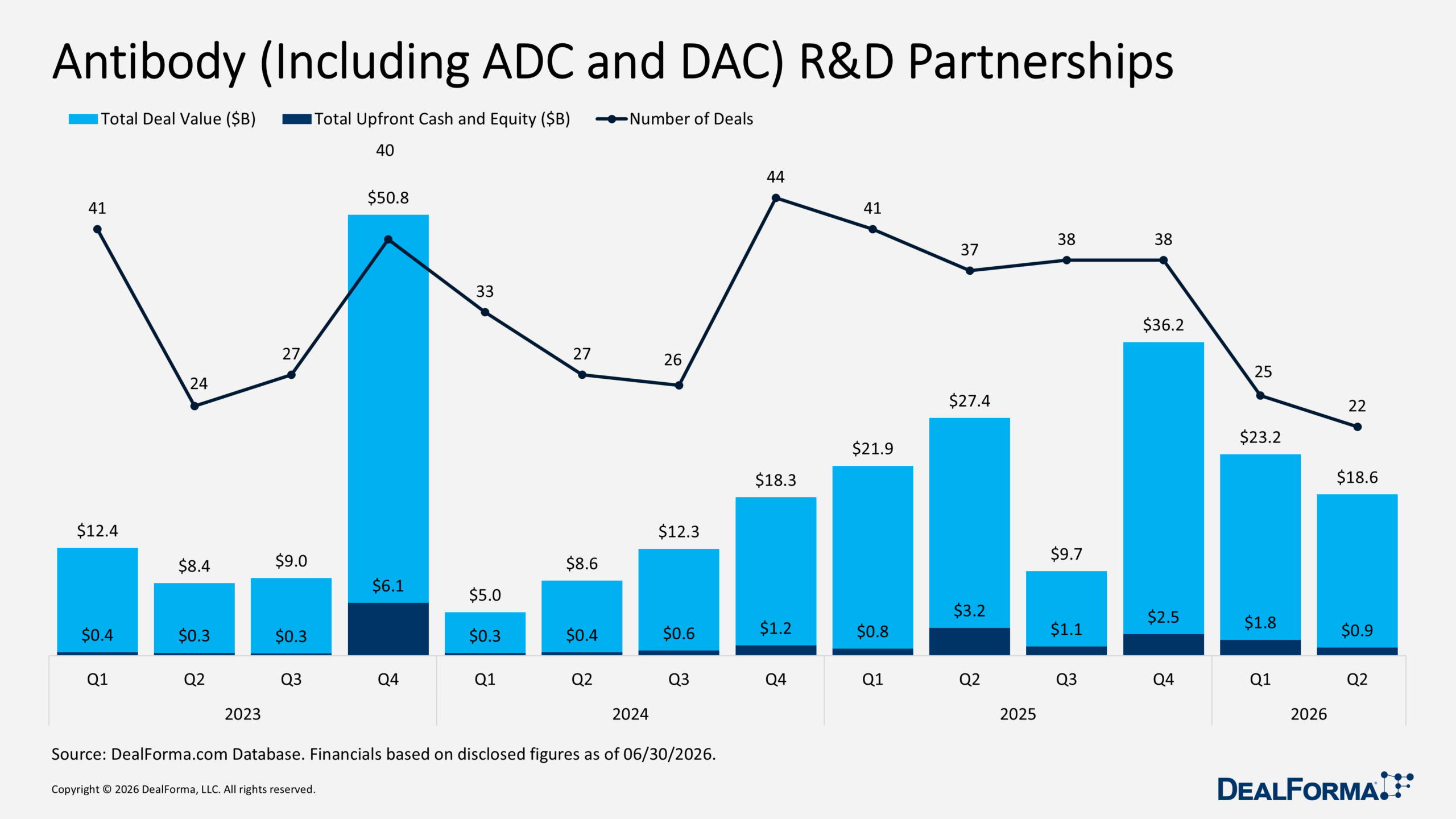
Antibody R&D partnerships, spanning ADC and DAC deals, slowed in Q2 2026. The quarter produced 22 transactions totaling $18.6B in potential value, down from 25 deals totaling $23.2B in Q1 2026. Upfront cash and equity contracted sharply, falling to $900M from $1.8B. Average upfront payments dropped from $205M to $133M, and the median fell from $100M to just $20M. Together, these figures point to smaller initial commitments in Q2, even as headline deal values stayed substantial. For the H1 of 2026, the sector closed 47 antibody R&D partnerships worth $41.8B, backed by roughly $2.7B in upfront cash and equity.
Prominent Antibody R&D Partnerships in H1 2026
Innovent Biologics development and commercialization deal with Pfizer – May 2026
Innovent Biologics granted Pfizer exclusive worldwide rights to develop and commercialize 12 cancer therapies, comprising eight Innovent-originated candidates and four Pfizer discovery-stage programs spanning antibody-drug conjugates (ADCs) and multispecific antibodies. Innovent leads discovery through Phase I across all 12 programs using its proprietary platform, after which Pfizer assumes global late-stage development and commercialization, pairing Pfizer’s global clinical, regulatory, and commercial capabilities with Innovent’s cancer research and early-stage discovery strengths. The programs split into three structures: Pfizer takes exclusive worldwide rights and full global development costs for 4 programs; exclusive rights outside Greater China plus most development expenses for another four; and worldwide co-development of four programs with shared costs, US and Europe co-commercialization, and profit splits, with Innovent retaining exclusive Greater China rights. Innovent receives $650M up front and up to $9.9B in development, regulatory, and commercial milestones plus up to double-digit royalties.
Innovent development and commercialization deal with Eli Lilly – February 2026
Innovent, through its wholly owned subsidiaries Innovent Biologics (Suzhou), Fortvita Biologics (Singapore), Fortvita Biologics Inc., and Fortvita Biologics (USA), granted Lilly exclusive worldwide ex-China rights to develop and commercialize antibodies for cancer and immunology indications. Innovent leads early research and clinical development through Phase II in China, drawing on its antibody platforms and clinical capabilities, after which Lilly takes over development and commercialization, while Innovent retains rights in Greater China. Innovent receives $350M up front and up to $8.5B in development, regulatory, and commercial milestones plus tiered royalties.
Antibody (Including ADC and DAC) M&A
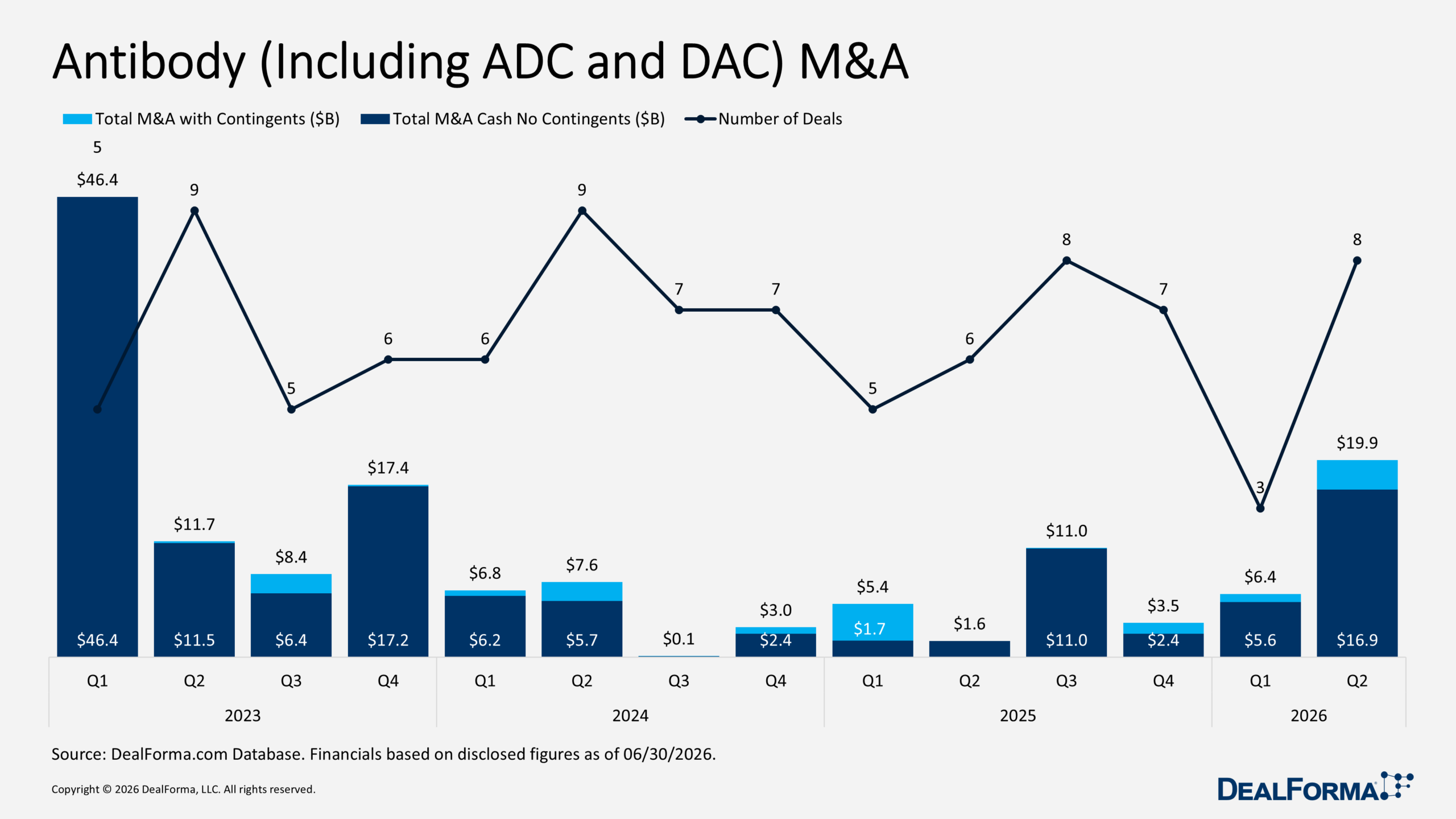
Antibody M&A, including ADC and DAC transactions, accelerated sharply in Q2 2026. The quarter delivered 8 deals worth $19.9B in total potential value, up from just 3 deals worth $6.4B in Q1 2026. Cash consideration excluding contingents rose steeply as well, climbing to $16.9B from $5.6B, while the average upfront deal value increased from $1.9B to $2.4B. The median upfront value, however, fell from $1.9B to $1.0B, a divergence that points to a mix of smaller transactions alongside a few outsized acquisitions that pulled the average higher. Across the H1 of 2026, the sector recorded 11 antibody M&A deals worth $26.3B including contingents, with $22.5B in cash excluding contingents.
Prominent Antibody M&A in H1 2026
AbbVie acquiring Apogee Therapeutics – June 2026
AbbVie is acquiring Apogee Therapeutics, whose lead asset is Phase II zumilokibart, a subcutaneous, half-life-extended monoclonal antibody targeting IL-13 for atopic dermatitis, with Phase III expected to begin in 2H 2026 and additional Phase I studies underway in asthma and eosinophilic esophagitis. Apogee’s broader pipeline includes Phase I APG-279, a combination of zumilokibart and APG-990 for atopic dermatitis with proof-of-concept (PoC) data expected in 2H 2026; Phase I APG-808 for asthma; and preclinical APG-273, which pairs zumilokibart with the TSLP-blocking APG-333 for asthma and COPD. The deal strengthens AbbVie’s immunology pipeline and deepens its clinical presence in respiratory medicine. Both boards have unanimously approved the transaction, which is expected to close in Q3 2026, with Apogee shareholders receiving $135.11 per share in cash for a total equity value of approximately $10.9B, a 49% premium to the June 18, 2026, closing price.
Gilead acquired Tubulis – April 2026
Gilead acquired Tubulis, whose lead assets are Phase I/II TUB-040, a NaPi2b-directed topoisomerase-I inhibitor (TOPO1i) ADC for platinum-resistant ovarian cancer and non-small cell lung cancer (NSCLC), and Phase I/II TUB-030, a 5T4-targeted ADC for solid tumors, alongside a preclinical pipeline spanning TUB-050, TUB-060, DC-TB-118, DC-D-134, and DC-P-234 for solid tumors, plus TUB-010 and TUB-020 against undisclosed targets. The transaction also brings Gilead the Tubulis ADC platform, broadening its ADC capabilities in cancer. Tubulis shareholders will receive $3.2B up front and up to $1.9B in contingent milestones. Announced in April 2026 and expected to close in Q2 2026, the acquisition was completed on May 21, 2026.
Antibody (Including ADC and DAC) Venture Funding
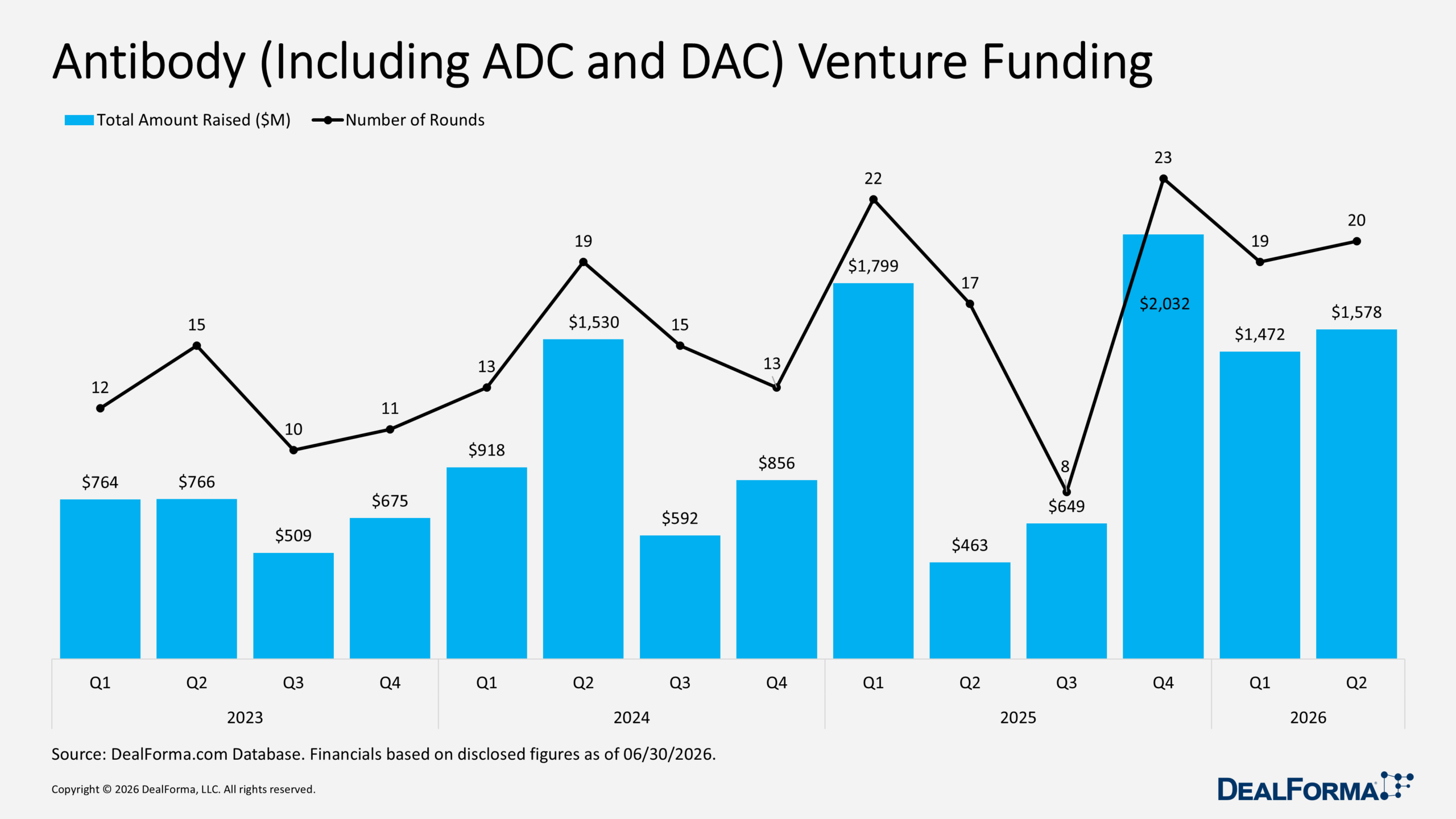
Antibody-focused venture funding, including ADC and DAC companies, edged higher in Q2 2026. The quarter drew $1.6B across 20 financing rounds, up modestly from $1.5B over 19 rounds in Q1 2026. Both capital raised and round count rose modestly, signaling steady appetite into the second quarter. For the H1 of 2026, the sector recorded 39 venture rounds raising a combined $3.1B.
Prominent Antibody Venture Funding in H1 2026
Korsana Private $380M – April 2026
Cyclerion Therapeutics (Nasdaq: CYCN) and privately held Korsana Biosciences signed a definitive all-stock merger, with the combined company operating as Korsana Biosciences under the Nasdaq ticker KRSA. Korsana’s lead program, KRSA-028, is a next-generation shuttled monoclonal antibody targeting amyloid beta for Alzheimer’s disease, built on the proprietary THETA platform, which pairs clinically validated transferrin receptor (TfR1) and Fc engineering to improve brain delivery, boost amyloid plaque clearance, cut amyloid-related imaging abnormalities (ARIA) and hematologic adverse events, and enable low-volume subcutaneous dosing; Korsana is the seventh Paragon Therapeutics company. A concurrent, oversubscribed $380M private financing, led by Fairmount and Venrock Healthcare Capital Partners, is structured as common stock and pre-funded warrants and extends the combined cash runway into 2029, funding KRSA-028 through phase 1 healthy volunteer data in mid-2027 and interim proof-of-concept data on plaque clearance by the end of 2027. Pre-merger, Cyclerion holders will own roughly 1.5% and Korsana stockholders roughly 98.5%, with both boards approving and closing expected in Q3 2026.
Ollin Biosciences Series B $330M – June 2026
Ollin Biosciences, Innovent Biologics’ (HKEX: 01801) ophthalmology partner, completed an oversubscribed $330M series B co-led by new investor TCGX and founding investor ARCH Venture Partners, with participation from a16z Bio+Health, Blackstone Multi-Asset Investing, Commodore Capital, Canada Pension Plan Investment Board (CPP Investments), RA Capital Management, accounts advised by T. Rowe Price Investment Management, and a leading sovereign wealth fund, alongside continued backing from Mubadala Capital and Monograph Capital. Proceeds fund global Phase 3 development of IBI324 (Ollin code: OLN324), a next-generation VEGF/Ang2 bispecific antibody engineered for higher Ang2 potency than faricimab, increased molar dosing versus both faricimab and aflibercept (including Eylea HD), and a smaller protein format, targeting DME and wet AMD in a $15B retina market, plus advancement of a second candidate into the clinic this year. In the 164-patient, randomized, head-to-head proof-of-concept JADE study against faricimab (Vabysmo), OLN324 delivered faster and greater retinal anatomic improvements in both DME and wAMD and numerically greater vision gains. Ollin has completed an End-of-Phase 2 meeting with the FDA and received EMA scientific advice and plans to start global Phase 3 trials in DME and wAMD in 2H 2026.
Antibody (Including ADC and DAC) IPO Activity
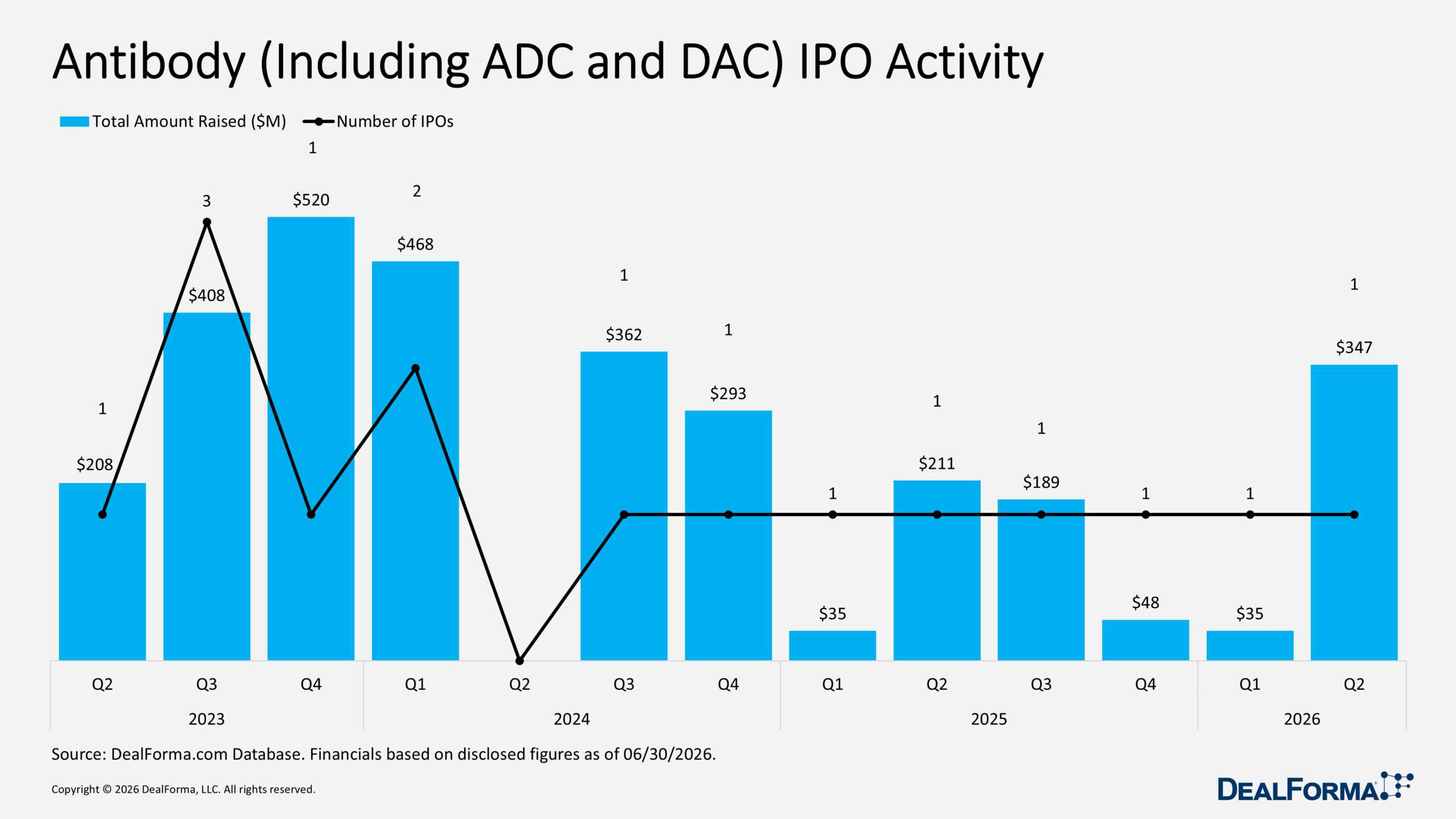
Antibody-focused IPO activity, including antibody conjugate and antibody degrader conjugate companies, stayed thin in Q2 2026 at a single listing, but proceeds jumped to $347M from just $35M on one IPO in Q1 2026. Although the number of offerings held steady, the far larger Q2 deal points to improved fundraising capacity for select antibody names. Across H1 of 2026, the sector recorded 2 antibody IPOs raising a combined $382M, with Q2 accounting for most of the total proceeds.
Prominent Antibody IPO Activity in H1 2026
Hemab Therapeutics IPO $346M – May 2026
Hemab Therapeutics Holdings (Nasdaq: COAG), a clinical-stage biotech developing therapies for blood coagulation disorders, closed its upsized IPO of 19,262,500 common shares at $18.00 per share, including the full exercise of the underwriters’ option covering 2,512,500 additional shares, for gross proceeds of approximately $347M before discounts and expenses. All shares were sold by Hemab, and the stock began trading on the Nasdaq Global Select Market on May 1, 2026, under the ticker COAG. Goldman Sachs, Jefferies, and Evercore ISI served as joint book-running managers, with Wedbush PacGrow as lead manager. Hemab’s clinical pipeline includes sutacimig (HMB-001), a bispecific antibody in development for the prophylactic treatment of Glanzmann thrombasthenia and Factor VII deficiency, and HMB-002, a monovalent antibody for the prophylactic treatment of Von Willebrand Disease.
IMBiologics IPO $35M – March 2026
IMBiologics (Kosdaq: 493280), a South Korean antibody developer founded in 2020 and focused on autoimmune diseases and immuno-oncology, priced its IPO at 26,000 won ($17.7) per share, the top of its 19,000 to 26,000 won range, offering 2,000,000 shares to raise 52B won (approximately $35M). Bookbuilding drew 2,333 domestic and overseas institutional investors at a competition ratio of 839.23:1, with the final price implying a market capitalization of about 384B won (approximately $260M). Korea Investment & Securities and Shinhan Investment & Securities served as underwriters. Institutional lock-up commitments were exceptionally strong despite early-March market volatility, with roughly 80% of participating institutions and about 76% of applied volume committing to mandatory lockups, and commitments of three months or longer reaching approximately 60% by institution count and about 56% by volume. IMBiologics listed on Kosdaq on March 20, 2026, and surged to a market capitalization of about 1.5T won ($1.0B) on debut, with proceeds funding nonclinical development of its core pipeline, new pipeline expansion, and R&D, led by bispecific antibody candidate IMB-101 for autoimmune conditions.
Also check out AI / Machine Learning R&D, M&A, Ventures & IPOs – H1 2026 Review