A brief review of strategic mergers and acquisitions for big pharma.
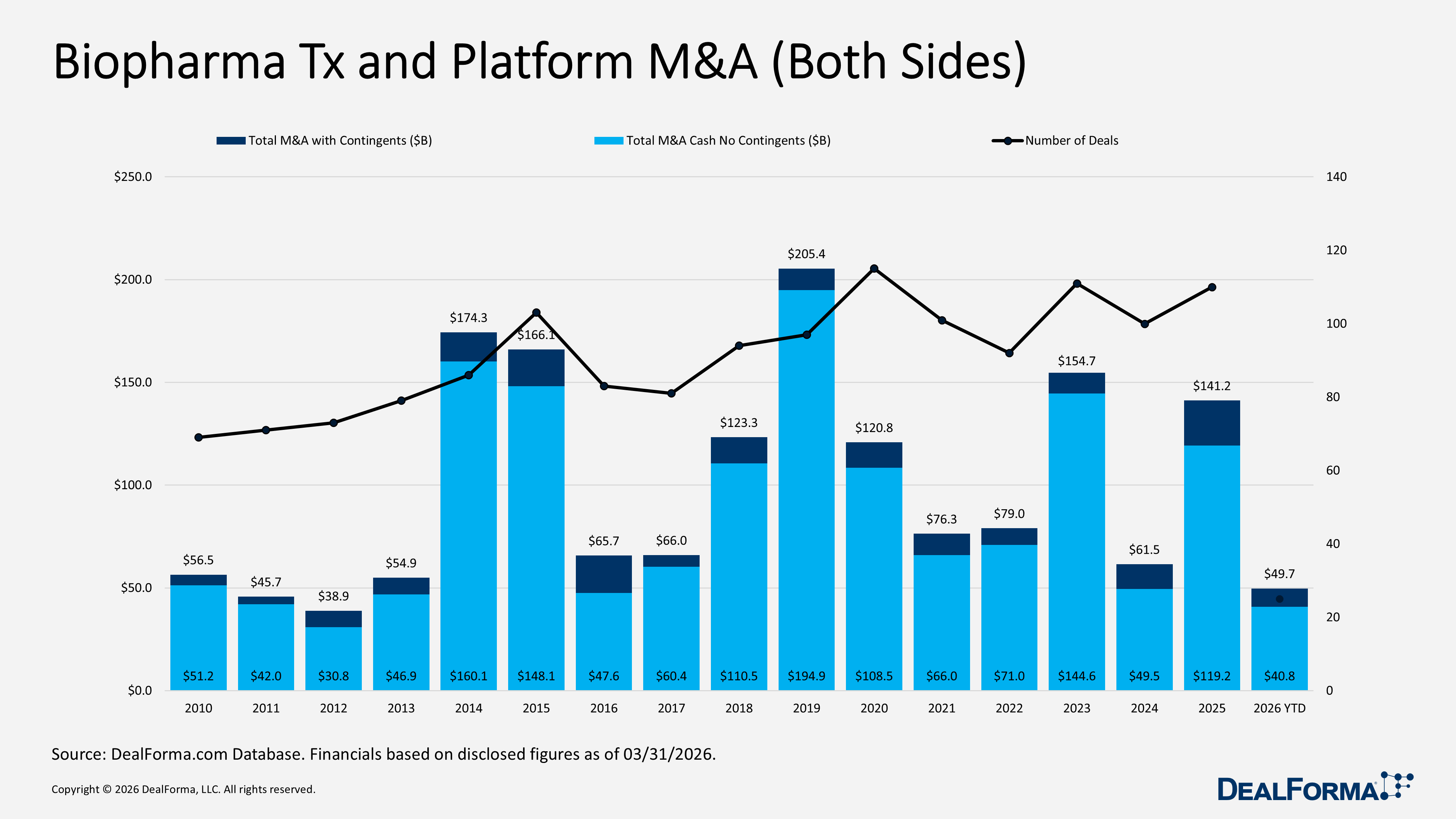
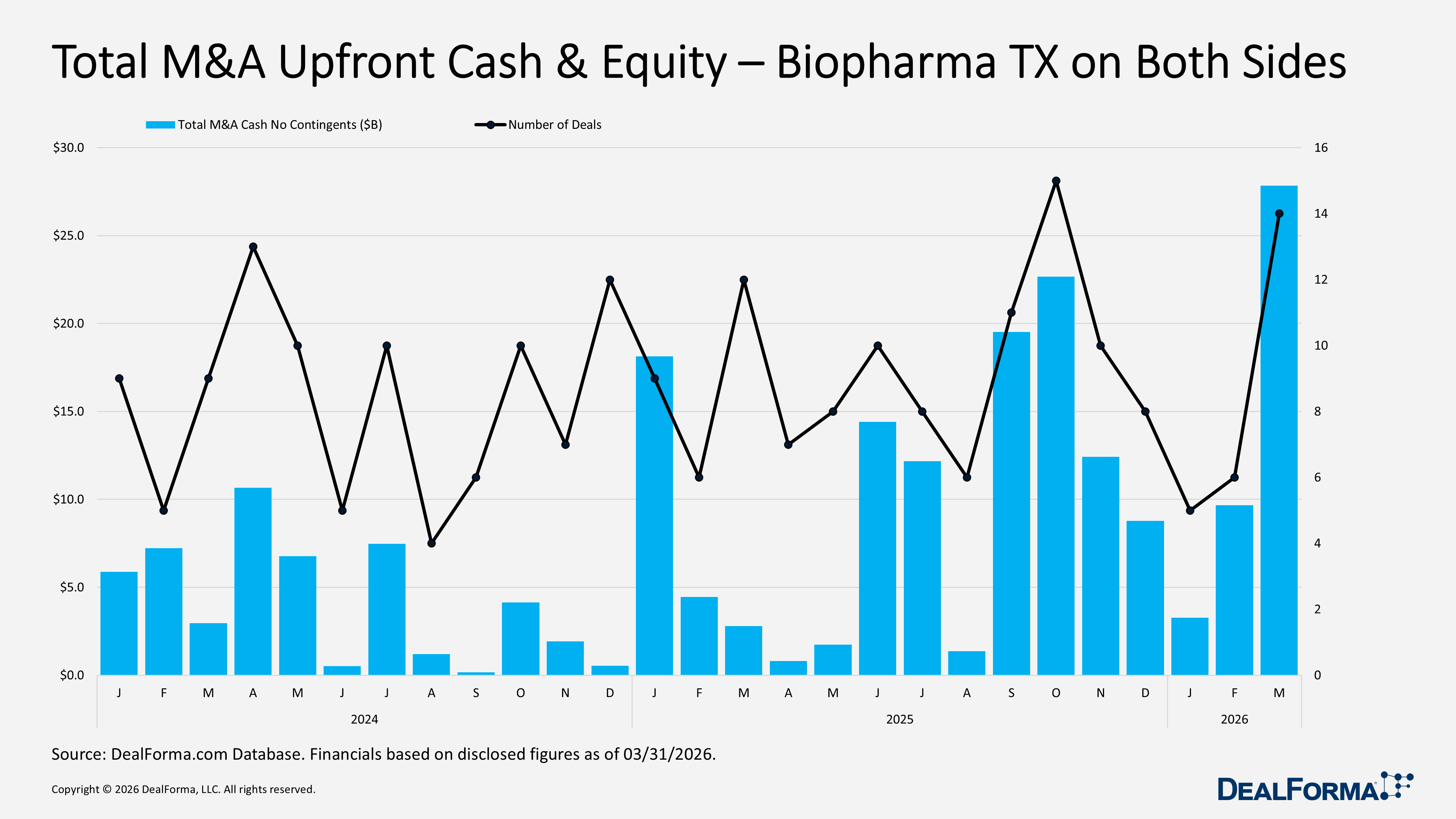
After a slow period of mergers and acquisitions for big pharma, activity has stepped up significantly since the start of 2024 leading to several purposeful purchases for the industry’s top pharma companies. In this piece we explore the frequency and type of recent M&As signed by big pharma supported with data from DealForma.
Analyzing deal data since the start of 2024, M&A activity in the pharma industry has returned to steady levels. This dealmaking has been largely driven by the top 20 pharma companies acquiring businesses in a bid to further claim and expand their focus in existing niche areas other than oncology, to highlight them out as leaders in specific therapeutic / technology fields.
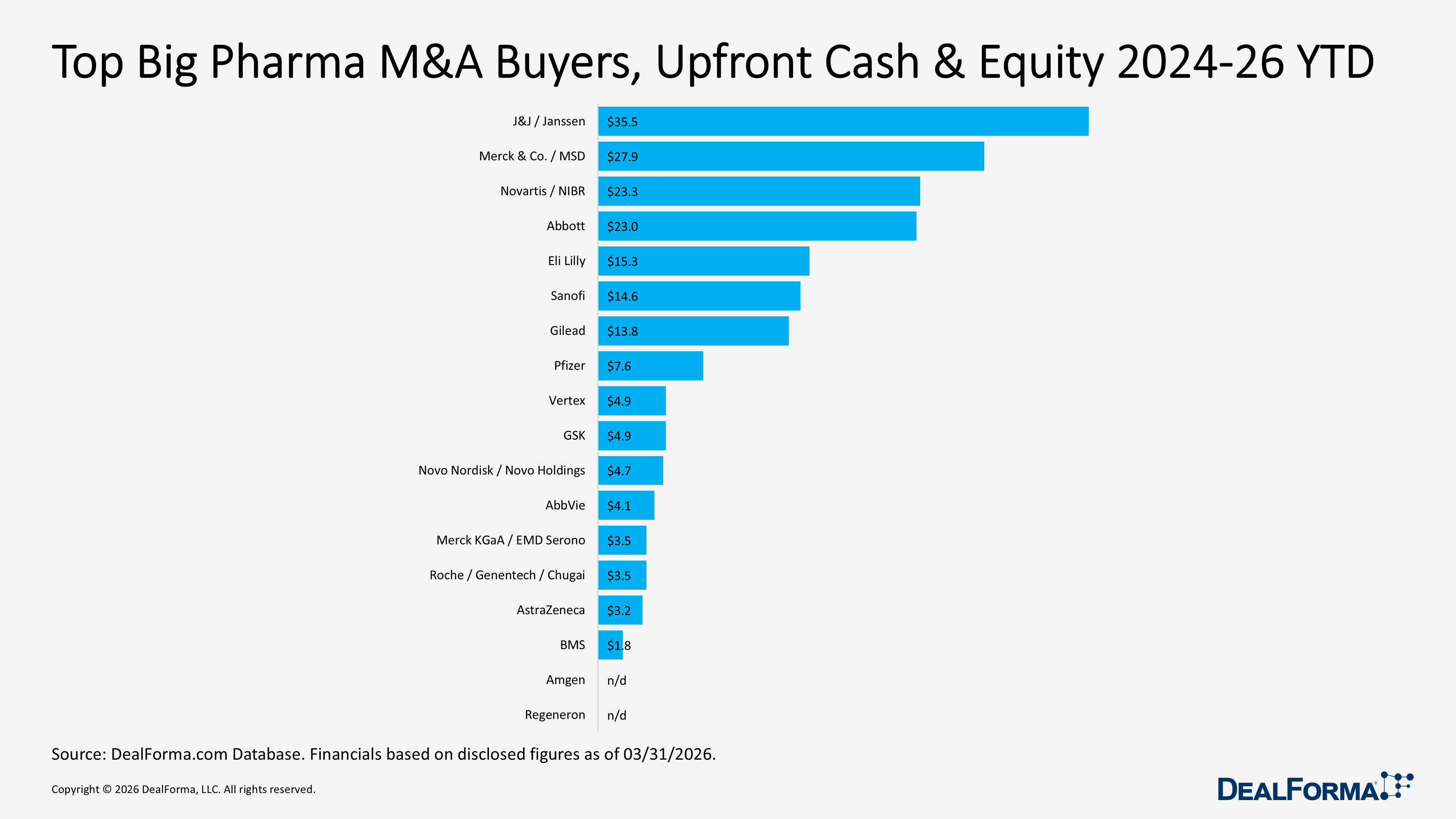
Swiss giant Novartis has been one of the most active acquirers signing over 10 deals since 2024. The company’s biggest recent deal was agreed in October 2025, the acquisition of Avidity Biosciences, a move that helped the company strengthen its presence further in neuroscience. The $12billion acquisition which was completed earlier this year granted Novartis with a series of antibody oligonucleotide conjugates (AOCs) developed to treat rare muscle disorders, including lead asset, phase 3 Delpacibart etedesiran which targets the gene DMPK to treat myotonic dystrophy. The agreement also handed Novartis an innovative RNA platform from Avidity, which could be key to the development of other therapies.
Prior to this in February 2024, Novartis splashed out $2.9billion on German Morphosys, this acquisition focused more on Novartis’ oncology pipeline as it brought with it late stage pelabresib, a leading myelofibrosis drug developed to treat a rare type of bone marrow cancer. Novartis also further bolstered its oncology offerings by acquiring Synnovation Therapeutics’ subsidiary Pikavation Therapeutics in March 2026 for $2billlion upfront, which brought along with it a lead asset SNV4818, which is a PI3Kα inhibitor targeted to treat the mutated PI3Kα enzyme present in cancer cells.
A handful of other healthy recent acquisitions including a $2billion buyout of allergy company Excellergy Inc. in March 2026, a $1.4billion acquisition of Tourmaline Bio in October 2025 including phase 3 antibody pacibekitug and a $800million Regulus Therapeutics purchase in April 2025 has provided Novartis with diverse products in areas other than neurology and oncology, including anti-IgE, renal and cardiovascular therapies.
Respiratory and infectious diseases spotlight
Although Novartis has been very active, Merck, Johnson and Johnson (J&J) and Eli Lilly have all been hot on its heels with a similar number of impressive strategic acquisitions effectively bringing the M&A scene back to life. Merck & Co. (known as MSD outside the U.S.) signed seven acquisitions since 2024. The company’s most recent notable deal was the acquisition of British biotech Verona Pharma for $10billion in July 2025, which completed in October of the same year. MSD quietly acquired the company and its U.S. FDA approved therapy Ohtuvayre. Ohtuvayre is a unique therapy as it’s the first medication in 20 years to treat chronic obstructive pulmonary disease (COPD). The therapy is also being trialed for other indications including cystic fibrosis and asthma which could massively increase its blockbuster potential. Continuing in the respiratory and infectious diseases area, Merck & Co. also acquired Cidara Therapeutics in November 2025 which included fungal infections therapies, approved Rezzayo designed to treat candidemia and invasive candidiasis and phase 1 Rezafungin, and influenza-targeted phase 3 CD-388 and CD377. The acquisition worth up to $9.2billion also includes programs for cancer, HIV and SARS-CoV-2. Other notable acquisitions included Merck KGaA’s $3.5 billion acquisition of SpringWorks Therapeutics, as well as Merck & Co.’s acquisitions of Terns Pharmaceuticals for $6.7 billion, and Harpoon Therapeutics and Abceutics for a combined $888 million.
Cardiovascular intervention
J&J has the usual interest in cancer therapies as many of the big pharma do, due its massive market potential. However, it has another well-known strong focus on medical devices within the cardiovascular intervention space, and this is nicely reflected in the two major medical device deals signed recently. First, in April 2024 J&J agreed to the acquisition of cardiovascular-focused Shockwave Medical through a $13billion deal. Through the deal, J&J will gain access to Shockwave’s innovative intravascular lithotripsy (IVL) technology, the only marketed platform of its kind able to treat calcified arterial lesions which can restrict blood flow in both coronary artery disease (CAD) and peripheral artery disease (PAD).
Later in 2024, through a smaller deal J&J also acquired V-Wave for $600million upfront. V-Wave has developed Ventura Interatrial Shunt (IAS) an innovative implantable device to relieve congestive heart failure. The deal further strengthens J&Js capabilities in cardiovascular disease and could be worth up to $1.1billion in milestone payments. Other acquisitions for J&J focused upon a range of different therapy areas—from neurology to dermatology. Targeting neurology, a closely lucrative area behind oncology, J&J’s $14.6 billion neuroscience-focused acquisition of Intra-Cellular Therapeutics in January 2025 provided it with ready-made big seller Caplyta, developed for Schizophrenia, as well as several other CNS clinical therapies. Turning its focus to dermatology led to two focused deals including its $850million acquisition of Proteologix in May 2024 and $1.25billion deal of Yellow Jersey Therapeutics through its subsidiary Cilag which gifted it with a preclinical bispecific antibody PX128 and NM-26 respectively both for the treatment of atopic dermatitis.
Non-stop buying spree
Another notable big pharma company to be competing in frequency with deals is Eli Lilly, which has also been on a major buying spree, purchasing four companies in 2025 alone, and five companies in 2026 already. Most of the deals were oncology-focused, at the start of 2025, Eli Lilly acquired Scorpion Therapeutics for $2.5billion which included phase 1/2 TX-478, a therapy program being developed for breast cancer and advanced solid tumors. In early 2026 Eli Lilly acquired Orna Therapeutics for a similar price of $2.4billion, gaining a foothold into the in vivo CAR-T field with Orna’s lead asset ORN-252, a CAR-T therapy targeting autoimmune diseases, driven by Orna’s circular RNA platform. Crossbridge Bio, Kelonia Therapeutics and Ajax Therapeutics have also been snapped up by Eli Lilly further bolstering its oncology hold.
Neurology was also an area in which Eli Lilly brought assets in through acquisitions, in May 2025, SiteOne Therapeutics was purchased in a billion-dollar deal that brought with it chronic pain non-opioid treatment STC-004. This was followed by two deals this year, the January 2026 $1.1billion acquisition of Ventyx Biosciences which although focused on inflammation-targeted oral therapies also included small molecule therapeutics in development for neurodegenerative diseases. In March 2026, Lilly announced that it would purchase Centessa Pharmaceuticals for approximately $7.8 billion in one of the highest value deals for the company. Centessa holds expertise of orexin receptor biology which plays a key role in the sleep-wake cycle, and the company has developed a pipeline of orexin receptor 2 (OX2R) agonists aimed to target sleep-wake disorders. This acquisition will help to diversify Lilly’s neurology portfolio, Centessa’s lead phase 2a clinical therapy cleminorexton is under development to treat narcolepsy 1 and 2. The buyout will also bring with it several OX2R agonists being trialed in neurological diseases.
Companies such as AbbVie, AstraZeneca, GSK and Sanofi have also been active on the M&A scene, each signing a handful of deals, well and truly breathing life back into the field since the lull in the early 2020’s, and this trend looks set to continue as companies gain momentum and seek to strengthen their key therapeutic areas.
Even though oncology remains the focus of most of the M&As for big pharma, the companies are also replenishing their other therapeutic strengths such as in cardiovascular, neurology and dermatological disorders, knowing that they could be the ultimate secret to their success as existing patents expire and new blockbusters take center stage.
Also check out Neurology R&D Partnerships, M&A and Venture Funding – Q1 2026 Review