In H1 2026, reverse merger and SPAC activity grew in breadth, not scale; more companies reached the public market, but each carried far less upfront value. The channel accelerated in Q2. Deal count rose to 12 from 5, up 140%. Total value, including contingents, more than doubled to $4.1B from $2.0B. Cash value excluding contingents rose to $2.4B. Yet the typical deal shrank sharply. Average upfront fell to $398M and the median to $198M, from $1.5B each in Q1.
Across the half, the channel produced 17 transactions, $6.1B in total value including contingents, and $3.9B in cash excluding contingents. De-SPACs accounted for a small share: 3 deals (17.6%), with the other 14 (82.4%) being conventional reverse mergers. For the market, the signal is clear: H1 growth reflects more companies going public, not larger deals.
Several deals anchored the half. PrimeGen US is going public via SPAC DT Cloud Star Acquisition Corporation at a $1.5B equity value, built on a mesenchymal stem cell platform in acute liver disease. ACEA Therapeutics is merging with Phoenix Asia for up to $1B to list Phase 3 NSCLC asset Abivertinib. Treeline Biosciences is merging with Standard BioTools in an all-stock deal, $2.5B for $460M, with more than $900M in pro forma cash for a pipeline in cancer, neurology, and immunology. Candid Therapeutics’ Rallybio merger was terminated in May 2026 and replaced with a UCB reverse merger, incurring a $50M termination fee. Talawar Tx is going public via SPAC JATT II Acquisition Corp. with a $225M PIPE for its bispecific I&I pipeline.
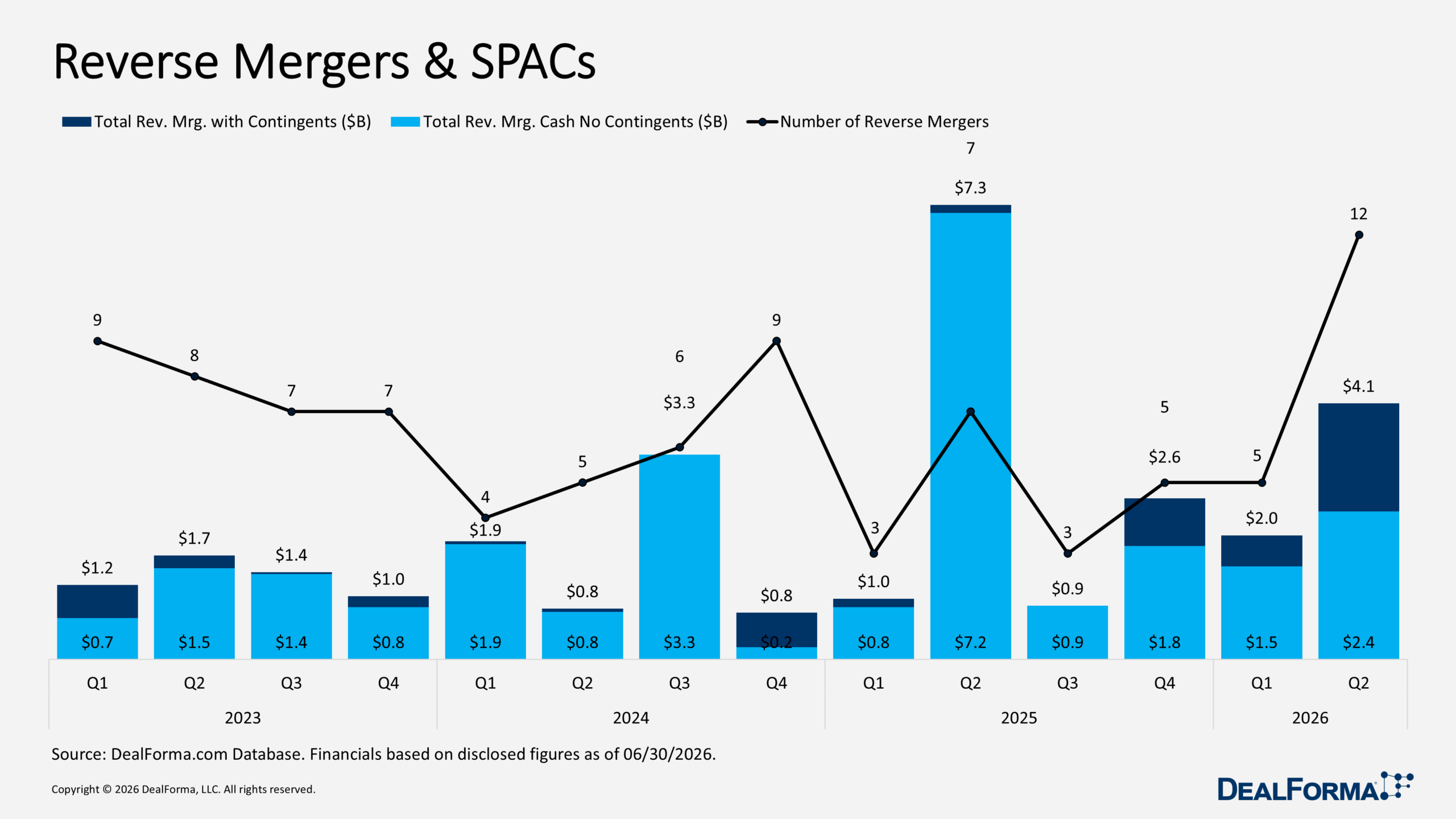
In Q2 2026, reverse merger and SPAC activity rose to 12 transactions from 5 in Q1, up 140% quarter-on-quarter. Total deal value, including contingent payments, more than doubled to $4.1B from $2.0B. That gain of $2.1B, or 105%, put Q2 at just over twice the Q1 level. Q2 alone accounted for roughly 67.2% of the $6.1B recorded in H1 2026. In total, H1 produced 17 reverse merger and SPAC transactions.
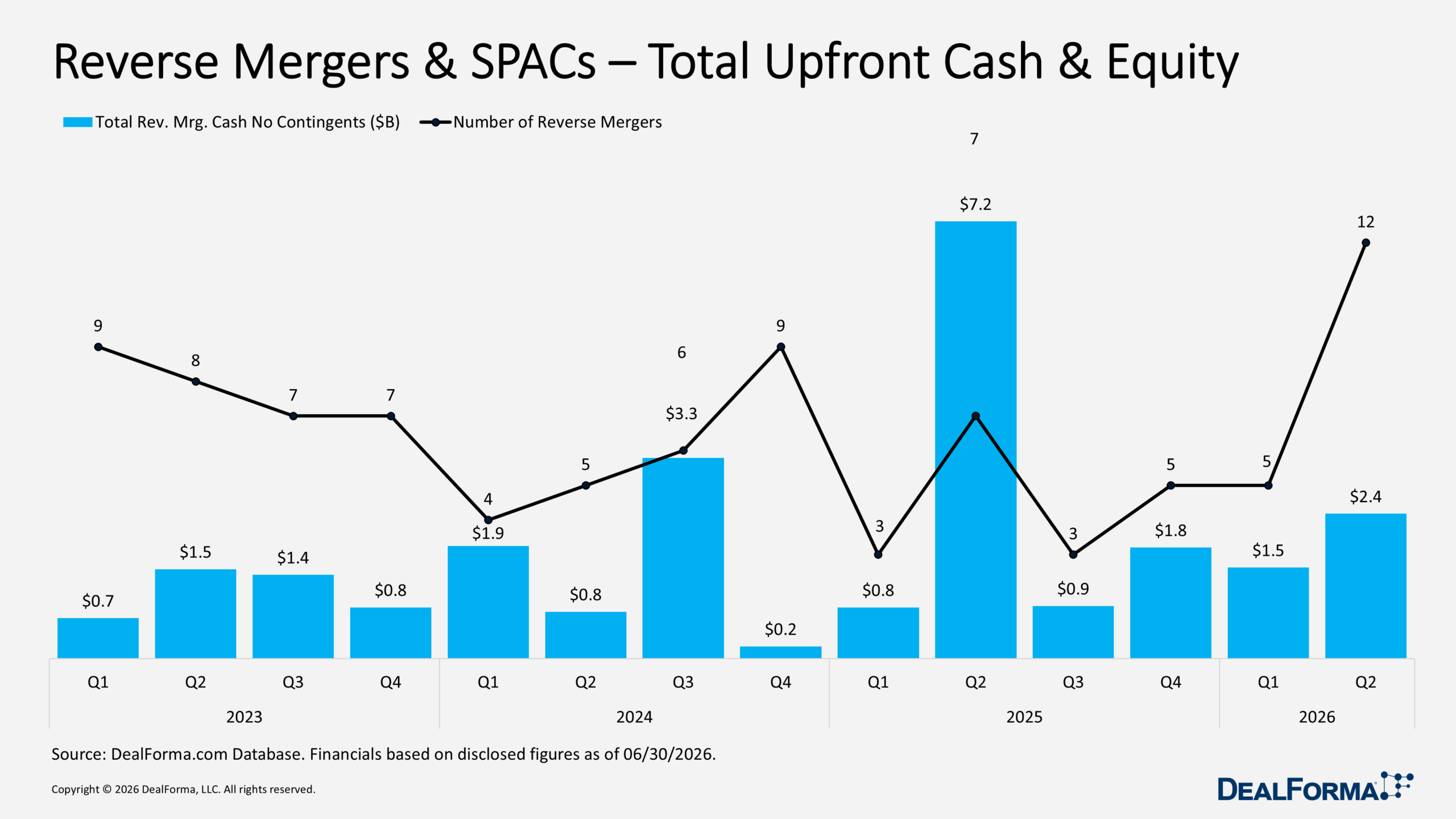
In Q2 2026, reverse merger and SPAC cash value excluding contingent payments rose to $2.4B from $1.5B in Q1. That gain of $900M, or 60%, lifted Q2 cash value to 1.6 times the Q1 level. Q2 accounted for roughly 61.5% of the $3.9B recorded in H1 2026, against 38.5% in Q1. The shift shows cash consideration strengthened notably in Q2.
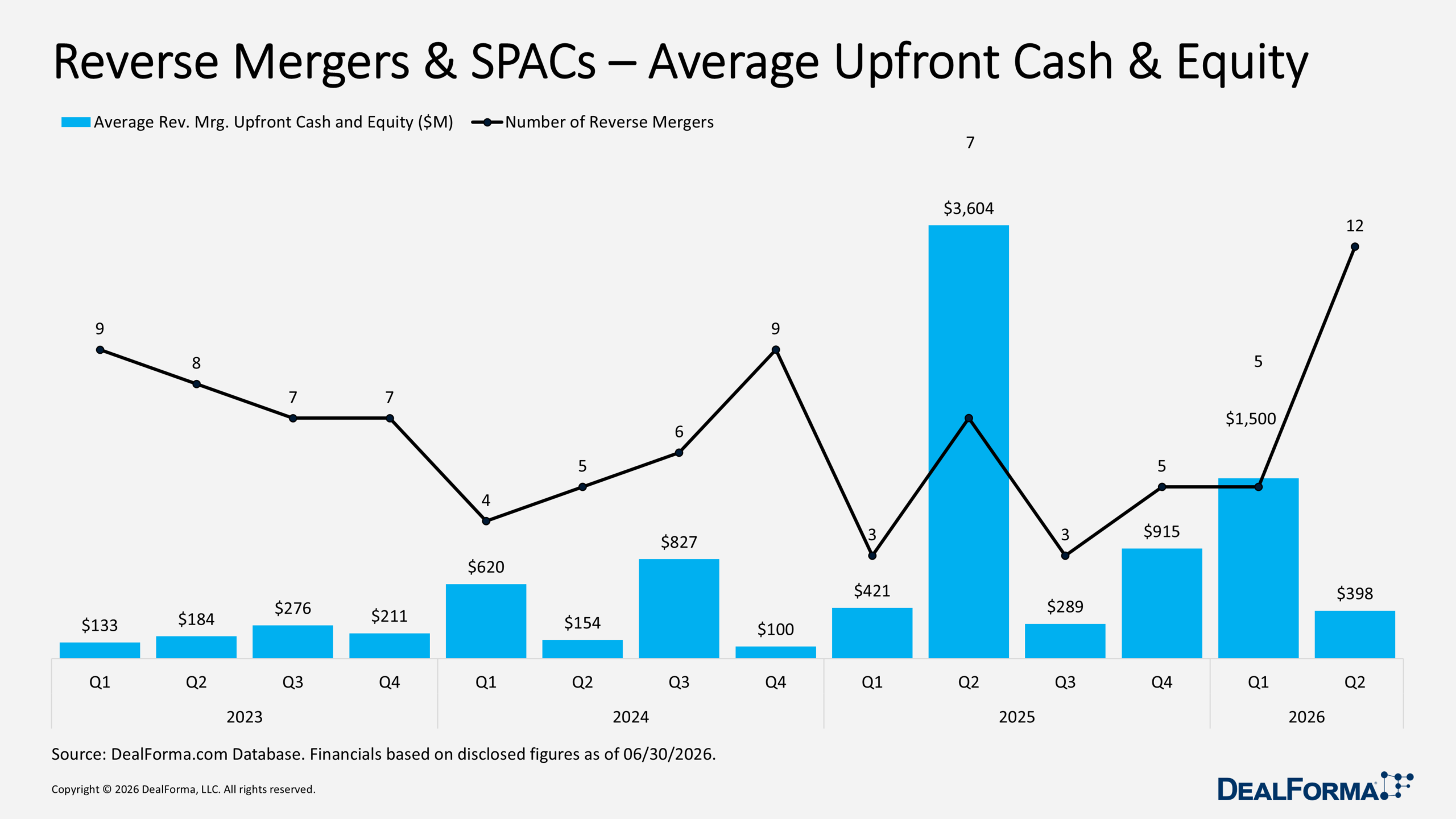
In Q2 2026, the average upfront cash and equity value for reverse mergers and SPACs fell sharply. The average dropped to $398M from $1.5B in Q1, a decline of $1.1B, or roughly 73.5%. That left the Q2 average at only about 26.5% of the Q1 level. The drop signals a marked shift toward smaller upfront transaction values in Q2.
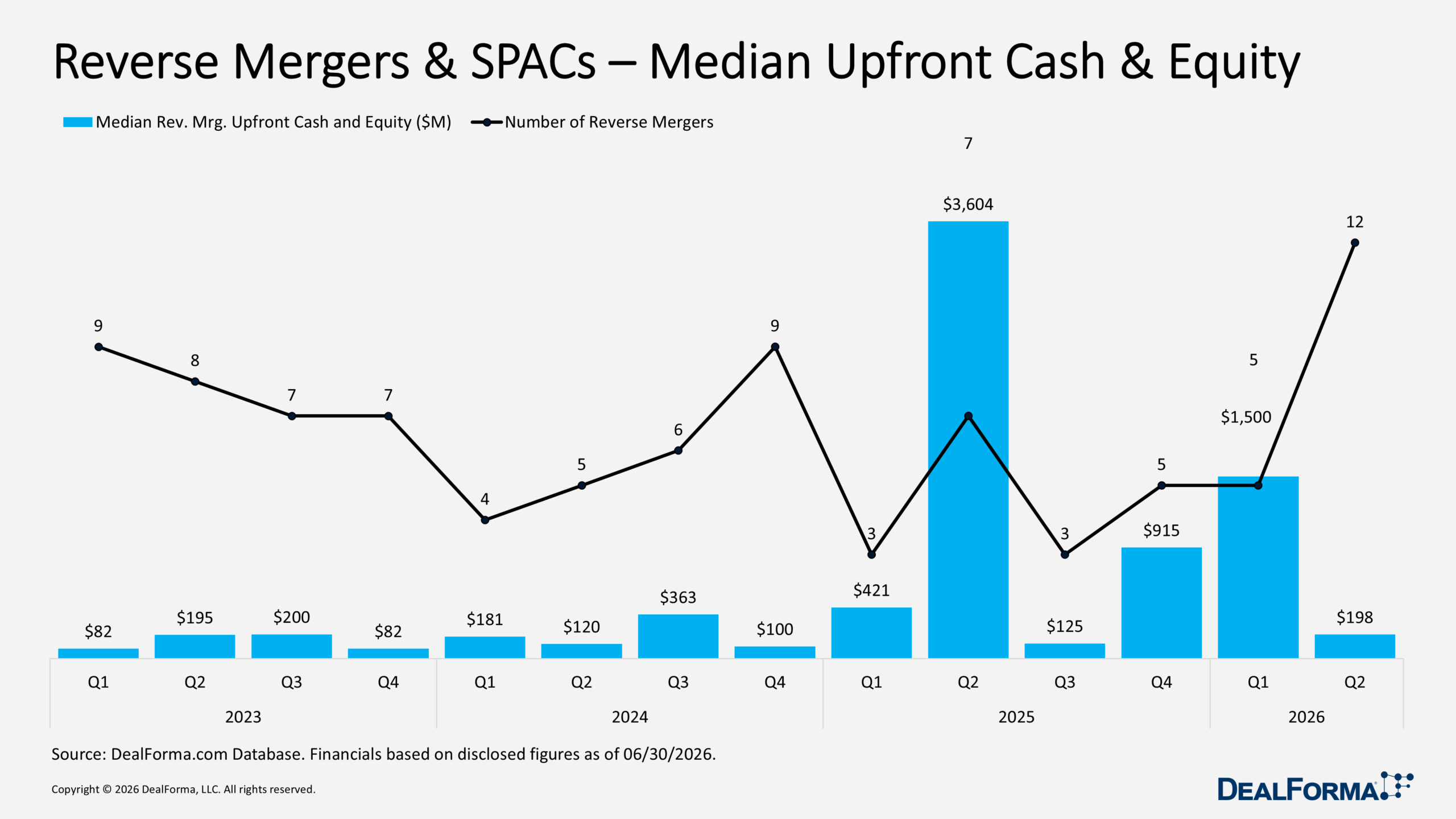
In Q2 2026, the median upfront cash and equity value for reverse mergers and SPACs dropped sharply. The median fell to $198M from $1.5B in Q1, a decline of $1.3B, or roughly 86.8%. That left the Q2 median at only about 13.2% of the Q1 level. The fall indicates the typical second-quarter transaction was substantially smaller in upfront value.
Total Number of Reverse Mergers and SPACs
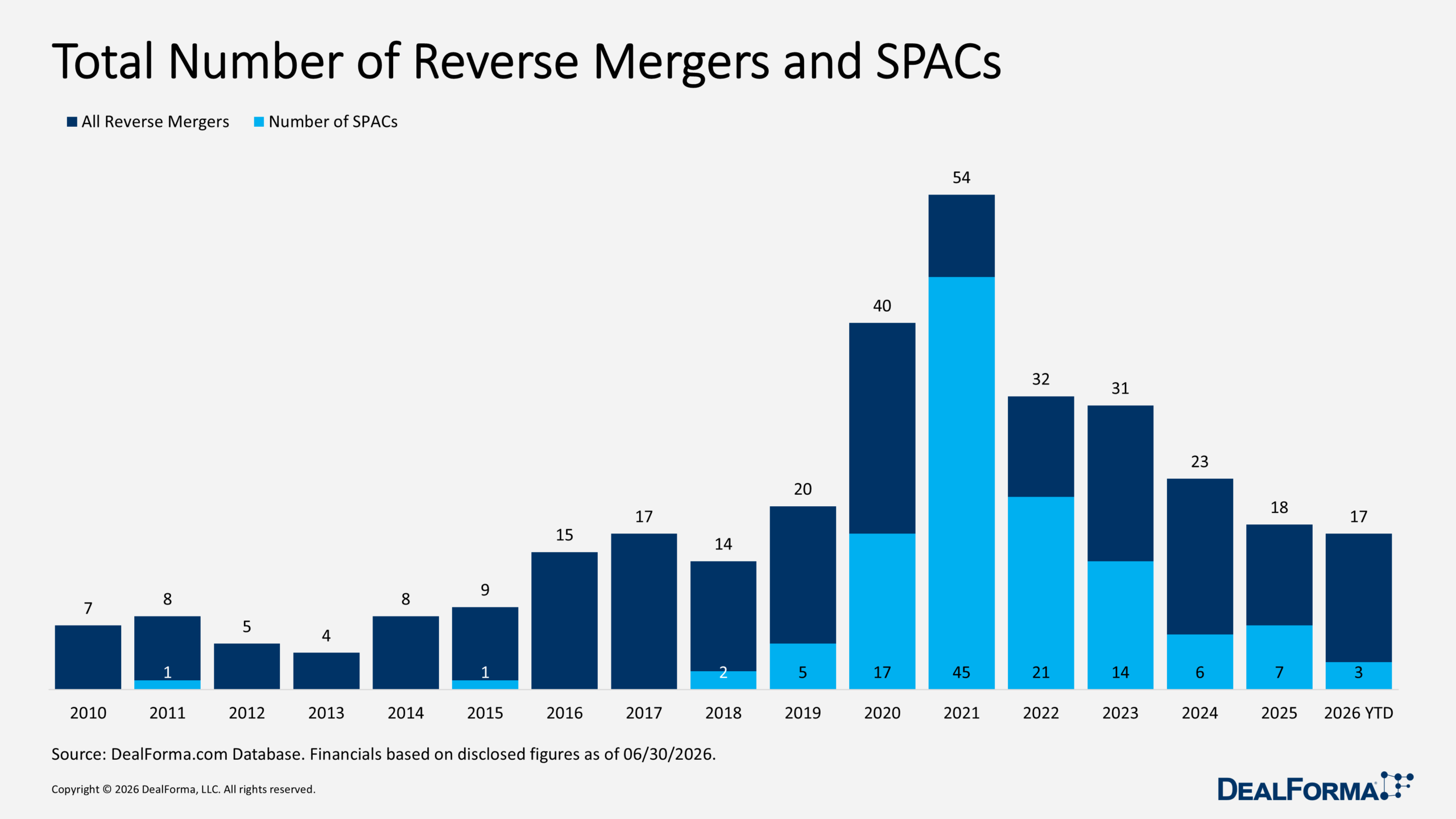
In H1 2026, reverse mergers totaled 17 transactions, of which 3 were de-SPACs. De-SPACs accounted for roughly 17.6% of the total. The remaining 14 transactions, or 82.4%, were other types of reverse mergers. DealForma data shows de-SPAC activity represented a relatively small share of the H1 2026 reverse merger market.
Prominent Reverse Mergers and SPACs in H1 2026
PrimeGen US reverse merging with DT Cloud Star Acquisition Corporation in a SPAC – February 2026
PrimeGen US is going public through a reverse merger with SPAC DT Cloud Star Acquisition Corporation on Nasdaq. The combined company keeps the PrimeGen US name, adopts a new ticker, and holds a $1.5B equity value. Its Triple Activated Mesenchymal Stem Cell (MSC) platform anchors the pipeline. The lead program targets acute alcoholic hepatitis and acute liver failure. It follows a completed FDA Pre-IND meeting in December 2025. Closing remains conditional and is expected in the second half of 2026.
ACEA Therapeutics reverse merging with Phoenix Asia – May 2026
ACEA Therapeutics, via subsidiary ACEA Pharma, is going public through a reverse merger with Phoenix Asia, renamed ACEA Pharma on Nasdaq. ACEA Therapeutics will own roughly 82% of the combined entity, retaining majority control. ACEA Pharma will receive up to $1B, funded by 100,000,000 newly issued ordinary shares at $10.00 per share. Lead small molecule Abivertinib is in Phase 3 for non-small cell lung cancer (NSCLC), with additional studies in B-cell lymphoma, prostate cancer, and COVID-19. The oncology and immunology pipeline adds Phase 1 AC-0058 (SLE), STI-6129 (AL amyloidosis, multiple myeloma), AC-0939 (AML, HCC), STI-1492 (RRMM), and preclinical AC-PRO. The merger lists ACEA’s diversified pipeline on Nasdaq.
Treeline Biosciences reverse merging with Standard BioTools for its public listing – June 2026
Treeline Biosciences is going public through an all-stock reverse merger with Standard BioTools, renamed Treeline Biosciences on Nasdaq under TRLN. Treeline shareholders will own roughly 84% and Standard BioTools shareholders about 16%, on valuations of $2.5B for Treeline against $460M for Standard BioTools. The company will hold more than $900M in pro forma cash. It develops small-molecule precision medicines across cancer, neurology, and immunology, with three Phase 1 programs, a fourth entering the clinic in 2026, and additional preclinical assets. Key shareholders of both companies signed 180-day lockups, and Standard BioTools holders receive CVRs tied to legacy asset sales, milestones, investments, and excess cash over five years, with no payments guaranteed. Closing is expected in the second half of 2026.
Candid Therapeutics reverse merging with Rallybio Terminated – Match 2026
Candid Therapeutics agreed to go public through a reverse merger with Rallybio, operating as Candid Therapeutics Inc. on Nasdaq under CDRX, with Candid surviving as a wholly owned Rallybio subsidiary. The deal implied valuations of $750M for Candid and $48M for Rallybio, with concurrent financing of over $505M. Pro-forma ownership would have been about 57.55% Candid, 3.65% Rallybio, and 38.80% concurrent financing investors. Candid’s autoimmune portfolio of T-cell engagers is led by cizutamig, with Phase 2 studies planned in 2026. Rallybio contributed Phase 1 RLYB-116 in complement-mediated disease (PNH, myasthenia gravis, APS), preclinical RLYB-332 and RLYB-114, and partnered ABCL-635 and KY-1066. On May 3, 2026, Candid terminated the deal, entered a reverse merger with UCB, and paid Rallybio a $50M termination fee.
Talawar Tx is reverse merging with JATT II Acquisition Corp. in a SPAC – June 2026
Talawar Tx is going public through a reverse merger with SPAC JATT II Acquisition Corp., operating as Talawar Therapeutics on Nasdaq under TLWR. The company will receive approximately $452M: $60M from JATT II’s SPAC trust (assuming no redemptions), a $225M PIPE, $120M pre-money equity, $17M sponsor equity for $150,000 JATT ordinary shares, and $30M ESOP. The $225M PIPE, led by Access Biotechnology, covers 22.5M shares at $10.00 per share. Talawar develops bispecific antibodies for immunology and inflammatory diseases (I&I). Lead asset TALA-125, an anti-IL-13 × anti-IL-18 bispecific for atopic dermatitis, enters trials in Q1 2027, with interim Phase 1 data in Q4 2027 and a Phase 2b proof-of-concept readout in H2 2028; discovery programs TALA-307 and TALA-711 follow. Both boards approved the deal, with closing expected in the second half of 2026.
Also check out Large-Cap Biopharma R&D Partnerships – H1 2026 Review