During H1 2026, large-cap biopharma R&D partnering was defined by concentration and back-weighted economics. A small group of buyers drove most deals and dollars, led decisively by Eli Lilly. Value clustered in cancer, with endocrine/metabolic emerging in a handful of megadeals, while upfront cash stayed modest against headline totals.
The 15 companies tracked signed 63 deals with a total potential value of $118.9B. Eli Lilly led on both, with 16 deals (about 25%) and $29.2B (nearly 25%). AstraZeneca ranked second in value at $18.5B on just 2 deals, ahead of BMS ($16.0B) and Pfizer ($11.9B); the top four held about 64% of value, and the six busiest firms about 65% of deals.
Upfront cash and equity totaled just $6.8B, showing how little headline value was paid at signing. AstraZeneca led at $1.2B, followed by BMS ($965M), Roche ($920M), and Lilly ($907M), together nearly 59% of the total. Lilly topped overall value but ranked fourth in upfront.
By therapeutic area, cancer dominated with 22 deals worth $54.8B, 57% of the $96.4B tracked, while endocrine/metabolic accounted for $24.1B (25%) across four deals; together, the two accounted for about 82% of the value.
The defining deals are CSPC Pharmaceutical and AstraZeneca, up to $18.5B in obesity and type 2 diabetes; Hengrui Pharma and BMS, up to $15.2B across oncology, hematology, and immunology; Innovent Biologics and Pfizer, up to $10.5B in ADCs and multispecifics; and Nurix Therapeutics and Roche, up to $2.3B on the Phase 3 BTK degrader bexobrutideg.
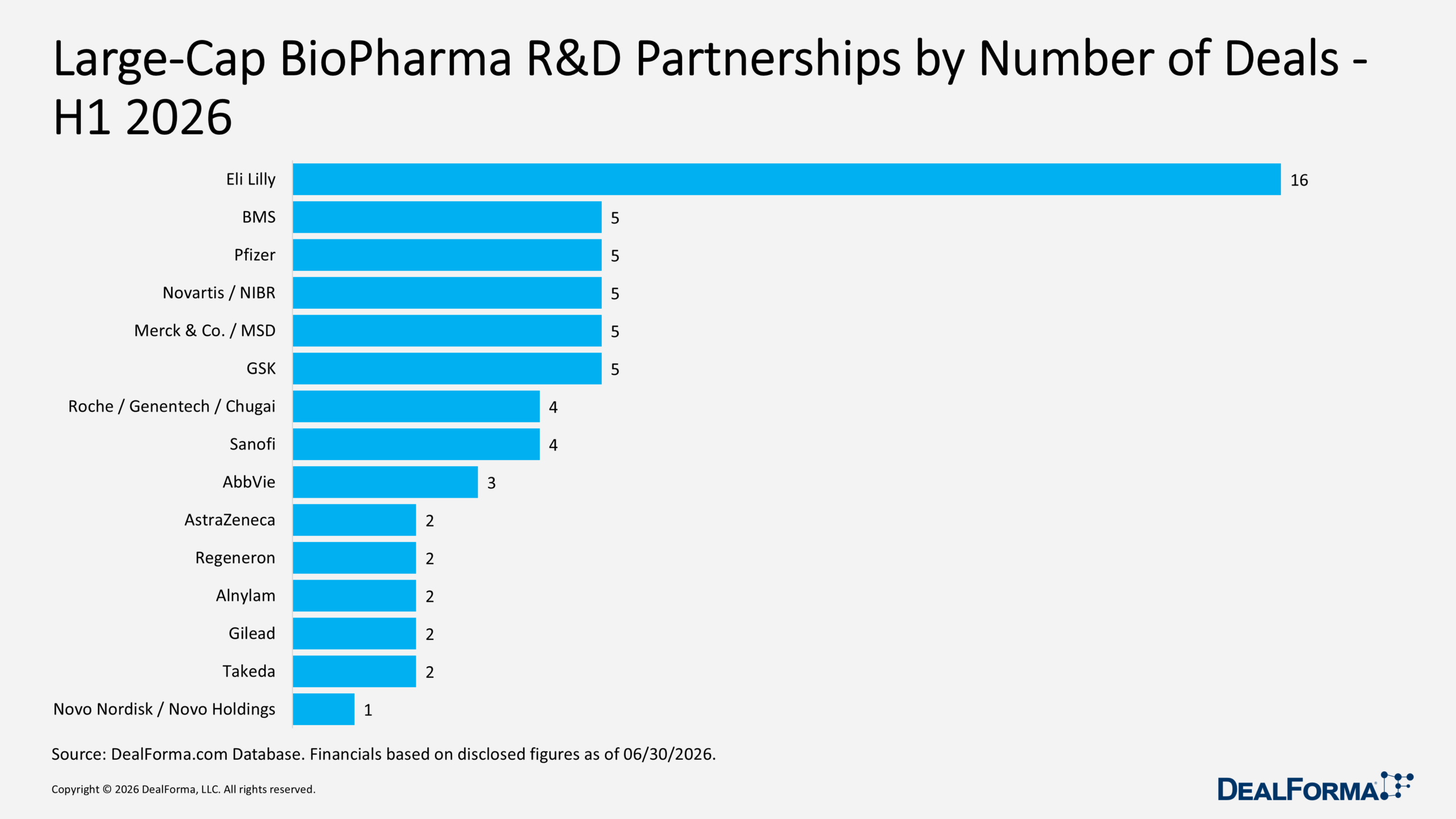
In H1 2026, R&D partnership activity among the 15 large-cap biopharma companies tracked (63 deals total) was highly concentrated. Eli Lilly led by a wide margin with 16 deals, roughly 25% of the total; BMS, Pfizer, Novartis/NIBR, Merck & Co./MSD and GSK each signed five; Roche/Genentech/Chugai and Sanofi four apiece; AbbVie three; AstraZeneca, Regeneron, Alnylam, Gilead and Takeda two each; and Novo Nordisk/Novo Holdings one. With Lilly alone accounting for a quarter of all deals and the six most active companies representing about 65% of the total, a small group of pharma leaders drove most of the industry’s external R&D dealmaking in H1.
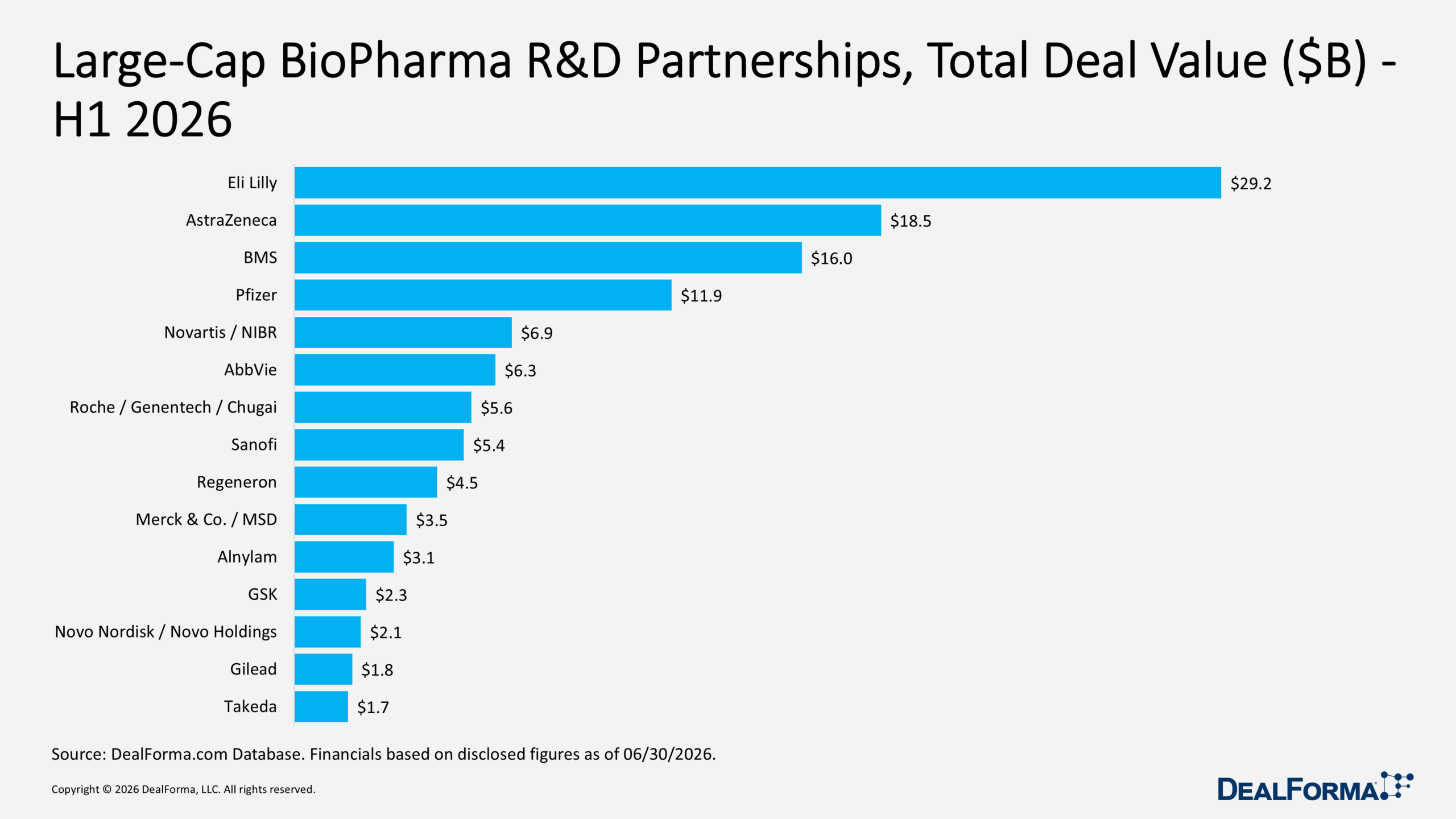
In H1 2026, large-cap biopharma announced $118.9B in total potential R&D partnership value, even more concentrated than deal volume. Eli Lilly led by a wide margin at $29.2B, nearly 25% of the total. AstraZeneca ranked second at $18.5B on just 2 deals, underscoring the unusually large potential value of its partnerships, followed by BMS at $16.0B and Pfizer at $11.9B; together, these four accounted for about 64% of total deal value. The next tier comprised Novartis/NIBR ($6.9B), AbbVie ($6.3B), Roche/Genentech/Chugai ($5.6B), Sanofi ($5.4B), and Regeneron ($4.5B), while Merck & Co./MSD, Alnylam, GSK, Novo Nordisk/Novo Holdings, Gilead, and Takeda each recorded less than $4B. Lilly stood out for combining high deal activity with high spending, while AstraZeneca pursued fewer but potentially much larger partnerships.
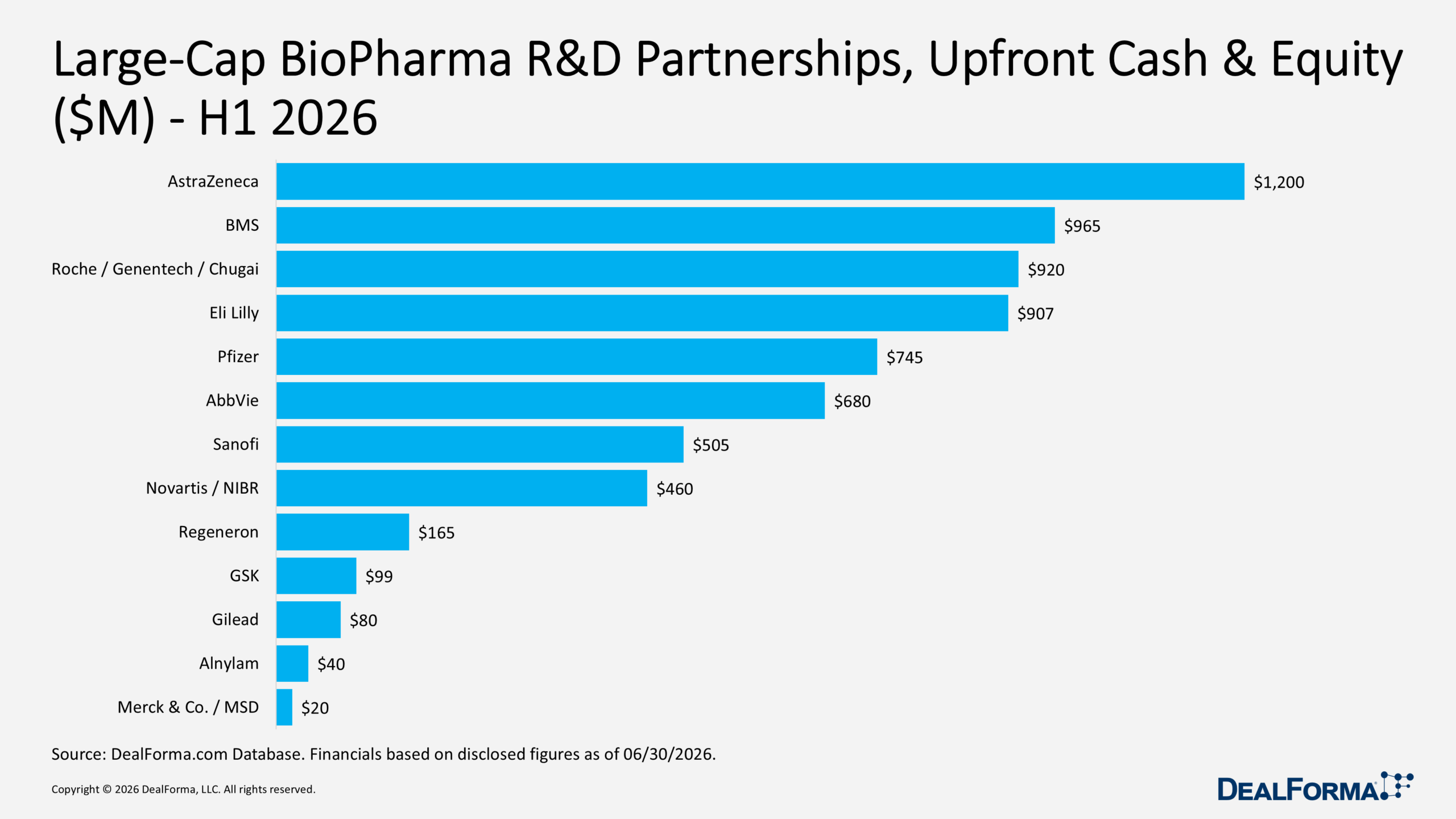
In H1 2026, large-cap biopharma committed a combined $6.8B in upfront cash and equity across R&D partnerships. AstraZeneca led at $1.2B, followed by BMS at $965M, Roche/Genentech/Chugai at $920M, and Eli Lilly at $907M; together, these four accounted for nearly 59% of total upfront commitments, concentrating immediate investment among a small group of buyers. Pfizer ($745M), AbbVie ($680M), Sanofi ($505M) and Novartis/NIBR ($460M) also made sizeable payments, while Regeneron, GSK, Gilead, Alnylam and Merck & Co./MSD committed much smaller amounts, and Novo Nordisk/Novo Holdings and Takeda recorded no disclosed upfront cash or equity. The gap between headline value and immediate spending is telling; Eli Lilly led overall partnership value at $29.2B but ranked fourth in upfront commitments, while AstraZeneca ranked first in upfront payments on just two deals, indicating that deal structures varied widely in how much value was paid at signing versus tied to milestones and other contingent payments.
Large-Cap Biopharma R&D Partnerships by Therapeutic Area Focus – H1 2026
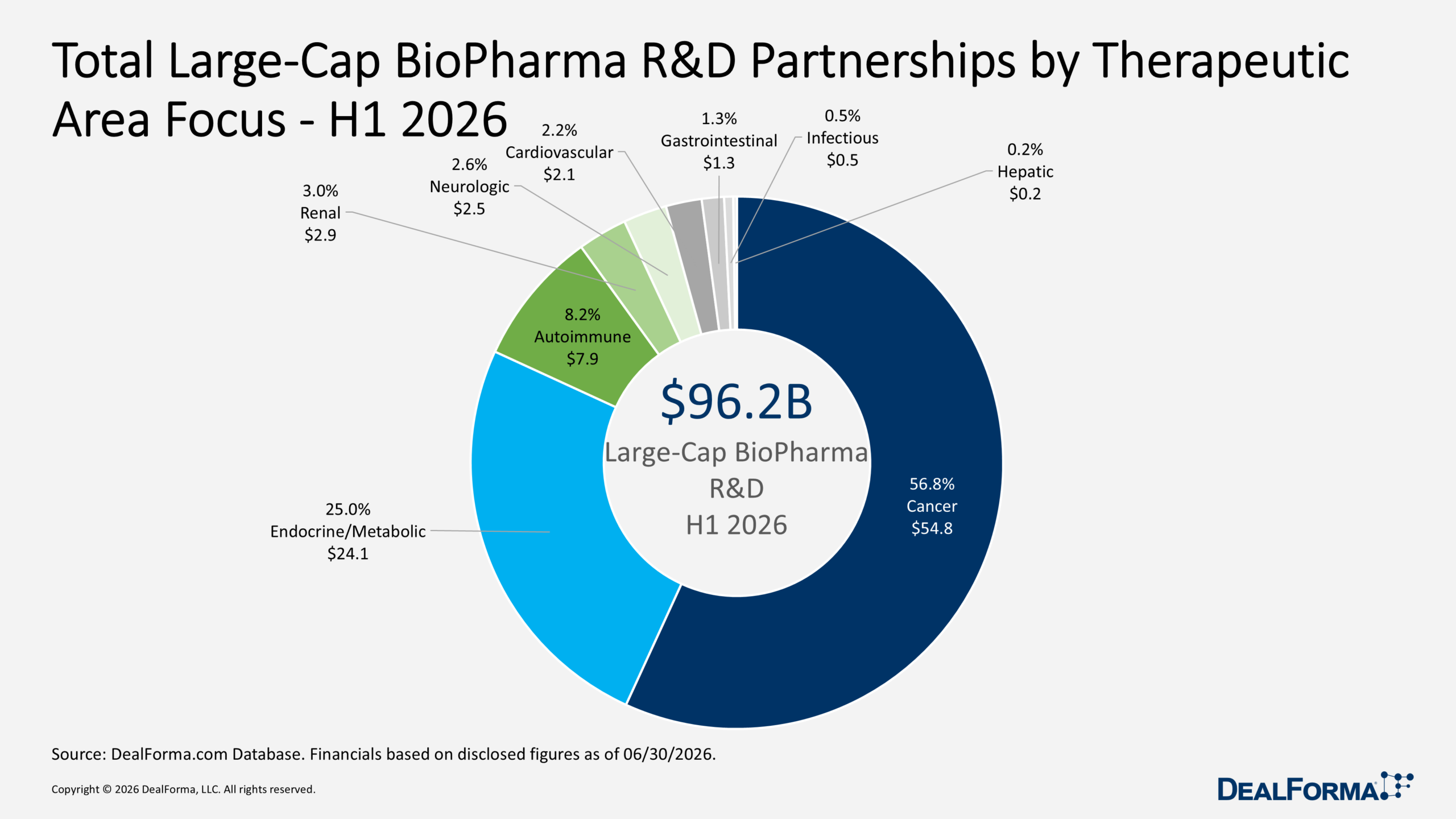
In H1 2026, large-cap biopharma R&D partnering was heavily concentrated in cancer, which led with 22 deals worth $54.8B, or 57% of the $96.4B in therapeutic-area deal value tracked, generating about $3.7B in upfront cash and equity. Endocrine/metabolic ranked second with only four deals but $24.1B in potential value (25% of the total), largely reflecting a few very high-value deals, including AstraZeneca’s $18.5B contribution. Autoimmune followed with four deals worth $7.9B (8%), while renal recorded two deals worth $2.9B and neurologic three worth $2.5B, each around 3%. Cardiovascular contributed $2.1B across two deals, with gastrointestinal, infectious, and hepatic areas accounting for comparatively small shares. Cancer remained the clear priority for large-cap partnering, while endocrine/metabolic emerged as a major value driver despite far fewer transactions, the two areas together accounting for about 82% of total partnership value.
Top Large-Cap BioPharma R&D Partnerships in H1 2026
RemeGen development and commercialization deal with AbbVie – January 2026
RemeGen granted AbbVie an exclusive, worldwide ex-China license to develop, manufacture, and commercialize RC148, a Phase 2 PD-1/VEGF bispecific antibody being tested as monotherapy and in combination, including with antibody-drug conjugates (ADCs), across advanced solid tumors such as certain lung cancers. RemeGen receives $650M upfront and up to $5.0B in development, regulatory, and commercial milestones (breakouts not disclosed), plus double-digit tiered royalties. The milestone-weighted deal gives AbbVie an ex-China solid-tumor asset while RemeGen retains China rights and books substantial near-term capital.
Inceptive development and commercialization deal with Alnylam – June 2026
In a discovery-stage collaboration, Inceptive granted Alnylam rights to discover, develop, and commercialize RNAi therapies against an undisclosed target, pairing Alnylam’s RNAi expertise, siRNA datasets, and platform with Inceptive’s AI foundation models to sharpen candidate design and potency. Alnylam leads development under its Alnylam 2030 strategy while Inceptive supplies the AI, taking $30M upfront plus equity payments and up to $2.0B in preclinical, regulatory, and commercial milestones (breakout not disclosed). The milestone-weighted deal adds an AI design engine to Alnylam’s RNAi pipeline.
CSPC Pharmaceutical development and commercialization deal with AstraZeneca – January 2026
CSPC Pharmaceutical granted AstraZeneca exclusive, worldwide ex-Greater China rights to jointly develop and commercialize its 8 metabolic programs for obesity and type 2 diabetes, spanning a clinical-ready GLP-1R/GIPR agonist (SYH-2082), 3 preclinical programs, and 4 new programs on CSPC’s AI-driven peptide platform and once-monthly LiquidGel delivery. AstraZeneca leads later-stage work ex-Greater China; CSPC retains Mainland China, Hong Kong, Macau, and Taiwan, with an AstraZeneca option to co-commercialize there on approval. Per CSPC’s HKSE filing, CSPC receives $1.2B upfront, up to $3.5B in development and regulatory milestones, and up to $13.8B in commercial milestones, plus double-digit royalties, for up to $18.5B total, one of the period’s largest metabolic alliances.
Hengrui Pharma development and commercialization deal with Bristol Myers Squibb – May 2026
Hengrui Pharma granted BMS exclusive, worldwide, ex-China, Hong Kong, and Macau rights to develop and commercialize cancer, hematology, and immunology therapies across 13 early-stage programs (4 cancer and hematology from Hengrui, 4 immunology from BMS) on Hengrui’s platforms, plus a Hengrui option to co-develop 5 additional programs worldwide. Reciprocally, Hengrui gains China, Hong Kong, and Macau rights to BMS-originated assets and leads early clinical work to accelerate proof-of-concept, leaving later development to BMS. Hengrui receives up to $950M ($600M upfront, $175M at the first anniversary, and a contingent $175M second-anniversary payment in 2028), plus up to $14.3B in option fees for the 5 joint programs and milestones across all programs, and tiered royalties outside those markets, for up to $15.2B total.
Innovent development and commercialization deal with Eli Lilly – February 2026
Through subsidiaries Innovent Biologics (Suzhou) and Fortvita Biologics (Singapore, Inc., and USA), Innovent granted Lilly exclusive, worldwide ex-China rights to develop and commercialize antibodies for cancer and immunology in a discovery-stage collaboration. Innovent leads early research and clinical development through Phase 2 in China on its antibody platforms, while Lilly leads later development and commercialization, and Innovent retains Greater China rights. Innovent receives $350M upfront and up to $8.5B in development, regulatory, and commercial milestones (breakout not disclosed), plus tiered royalties, for up to $8.9B total, adding a platform-derived ex-China oncology and immunology antibody pipeline for Lilly.
Genhouse Bio development and commercialization deal with Gilead Sciences – February 2026
Genhouse Bio granted Gilead exclusive worldwide rights to develop and commercialize GH-31, an oral MAT2A-targeting synthetic lethal therapy for multiple solid tumors, now cleared for clinical trials in both China and the U.S. and set to begin a Phase 1 trial in China in Q1 2026. Genhouse receives $80M upfront and up to $1.5B in development, regulatory, and commercial milestones (breakouts not disclosed), plus double-digit tiered royalties, for up to $1.5B total. The milestone-weighted deal pairs a dual-cleared, near-clinic oral synthetic-lethal candidate with heavily back-weighted upside.
SiranBio development and commercialization deal with GSK – May 2026
SiranBio granted GSK exclusive, worldwide rights (excluding mainland China, Hong Kong, Macau, and Taiwan) to develop and commercialize SA-030, a Phase 1 siRNA therapy targeting activin receptor-like kinase 7 (ALK7) for cardiometabolic diseases, drawing on GSK’s oligonucleotide expertise across siRNA and antisense oligonucleotides (ASO). SiranBio leads clinical development through completion of Phase 1, after which GSK assumes development, regulatory filings, and commercialization in licensed territories. SiranBio receives up to $1.0B in combined upfront and development, regulatory, and commercial milestones (breakout not disclosed), plus tiered royalties, extending GSK’s oligonucleotide pipeline while SiranBio retains the excluded markets.
Quotient Therapeutics development and commercialization deal with Merck – March 2026
Quotient Therapeutics granted Merck rights to discover, develop, and commercialize novel drug targets for inflammatory bowel disease (IBD) using Quotient’s somatic genomics platform in a discovery-stage collaboration. Quotient receives $20M upfront and up to $2.2B in development, regulatory, and commercial milestones (breakout not disclosed), for up to $2.2B total. The small-upfront, milestone-weighted deal gives Merck a genomics-driven target-discovery engine in IBD with heavily back-weighted upside for Quotient.
Novartis research partnership with Antares Therapeutics – June 2026
Antares Therapeutics signed a discovery-stage research partnership with Novartis to discover and develop small-molecule therapies against historically undruggable cancer targets, using its discovery engine, covalent chemistry, chemical proteomics, computational chemistry, and machine learning. Novartis holds a worldwide option to develop and commercialize any resulting therapies; until exercise, Antares runs all research across a limited set of targets. Antares receives $105M upfront and up to $1.8B, including option-exercise fees and development, regulatory, and commercial milestones (breakout not disclosed), plus tiered royalties up to the low double-digits, for up to $1.9B total.
Vivtex development and commercialization deal with Novo Nordisk – February 2026
Vivtex granted Novo Nordisk exclusive, worldwide rights to develop and commercialize undisclosed oral therapies for obesity, diabetes, and related metabolic diseases, pairing Vivtex’s AI-driven gastrointestinal screening and formulation platform with Novo Nordisk’s peptide and protein engineering to improve oral bioavailability of drugs usually limited to injection. Vivtex leads research and formulation selection while Novo Nordisk handles global development and commercialization. Vivtex is eligible for up to $2.1B in total, spanning an upfront payment, research funding, and milestones (breakout not disclosed), plus tiered royalties, giving Novo Nordisk an AI-enabled route to oral metabolic biologics.
Innovent Biologics development and commercialization deal with Pfizer – May 2026
Innovent Biologics granted Pfizer exclusive, worldwide rights to develop and commercialize 12 cancer therapies (8 Innovent-originated, 4 Pfizer discovery-stage) centered on antibody-drug conjugates (ADCs) and multispecific antibodies, with Innovent leading discovery through Phase 1 before Pfizer takes global late-stage development and commercialization. The 12 splits into three tranches of four: Pfizer holds exclusive worldwide rights and full costs on the first; exclusive ex-Greater China rights while funding most costs on the second; and worldwide co-development, cost-sharing, US and Europe co-commercialization, and profit-split on the third, where Innovent keeps Greater China. Innovent receives $650M upfront and up to $9.9B in milestones (breakout not disclosed), plus up to double-digit royalties, for up to $10.5B total.
Parabilis development and commercialization deal with Regeneron – May 2026
Parabilis Medicines granted Regeneron worldwide rights to discover, develop, and commercialize antibody-helicon conjugates (AHCs) on its Helicon peptide platform across undisclosed therapy areas, with Regeneron initially pursuing 5 targets and an option to add more. Parabilis receives $125M ($50M upfront cash plus a $75M equity investment) and up to approximately $2.2B in development, regulatory, and commercial milestones (breakouts not disclosed) across the five targets, plus undisclosed option payments on expansion and low double-digit tiered royalties, for up to approximately $2.3B total. The deal gives Regeneron platform access to a novel AHC modality.
Nurix Therapeutics development and commercialization deal with Roche – June 2026
Nurix Therapeutics granted Roche exclusive, worldwide rights to jointly develop and commercialize bexobrutideg, an oral, brain-penetrant, highly selective small-molecule BTK degrader for hematology, immunology, and neurology, including chronic lymphocytic leukemia (CLL), multiple sclerosis (MS), and chronic spontaneous urticaria (CSU). The program spans an ongoing Phase 2 and Phase 3 CLL trial, further label-enabling hematology studies as monotherapy and in combination, and planned Phase 2 trials in MS and CSU, with the parties co-commercializing in the US (50/50 profit and loss), Roche leading ex-US, and development costs split 40% Nurix, 60% Roche. Nurix receives $700M upfront and up to $1.6B in milestones (breakouts not disclosed), plus low- to high-teens ex-US royalties, for up to $2.3B total, its substantial upfront reflecting the asset’s Phase 3 stage.
Earendil Labs development and commercialization deal with Sanofi – January 2026
Earendil Lab granted Sanofi exclusive, worldwide rights to develop and commercialize multiple bispecific antibodies for autoimmune and inflammatory diseases, combining Earendil’s AI-driven protein modeling and high-throughput validation platform with Sanofi’s clinical and commercial reach, with Sanofi leading development and commercialization of any resulting bispecifics. Earendil is eligible for up to $160M in upfront and near-term payments for early program milestones (breakout not disclosed) and up to $2.4B in development and commercial milestones, plus up to low double-digit tiered royalties, for up to $2.6B total. The milestone-weighted deal gives Sanofi a platform-derived bispecific pipeline in immunology.
Iambic development and commercialization deal with Takeda – February 2026
Iambic granted Takeda rights to develop and commercialize small-molecule therapies using Iambic’s AI drug discovery platform, including its NeuralPLexer protein-ligand prediction model and integrated high-throughput wet-lab, initially across cancer, gastrointestinal, and inflammation. Iambic receives an undisclosed upfront payment, research cost reimbursement, and technology-access payments, and is eligible for up to $1.7B in development and commercial milestones (breakouts not disclosed), plus royalties. The deal gives Takeda platform access to an AI-driven small molecule engine while leaving Iambic near-term funding and back-weighted milestone upside.
Also check out Large-Cap BioPharma M&A – H1 2026 Review