Q1 2026 ran on theme of obesity, diabetes, and broader metabolic diseases. Across partnerships, venture rounds, and the quarter’s lone IPO, endocrine and metabolic capital piled into incretin biology (GLP-1, GIP, amylin) and the race to make it oral and longer-acting.
R&D partnerships meant fewer deals but far bigger checks. Volume fell to 18 from 22, yet announced value more than doubled to $22.1 billion, and average upfront jumped to $435 million from $62 million. CSPC anchored the quarter, partnering with AstraZeneca across eight obesity and type 2 diabetes programs for $1.2 billion upfront and up to $17.3 billion in milestones. Novo Nordisk backed Vivtex’s oral-delivery platform (up to $2.1 billion), and Eli Lilly extended Nimbus for an oral metabolic small molecule (up to $1.3 billion in milestones).
Venture told the opposite story: more rounds, fewer dollars, one obsession. The count rose to 17 from 15, but total funding eased to $1.1 billion as capital spread wider. The three standouts were three ways to win the same market: eMed ($200 million) on obesity care delivery, Alveus ($197 million) on a next-generation GIP/GLP-1 injectable, and Ambrosia ($100 million) on an oral GLP-1 pill.
The IPO market produced one deal, but a big one. Issuance held at a single listing yet proceeds climbed to $560 million from $128 million. Medtronic’s diabetes spinout MiniMed raised $560 million at a $5.6 billion value but priced below its $25 to $28 range and slipped under its offer price soon after.
Endocrine/Metabolic R&D Partnerships
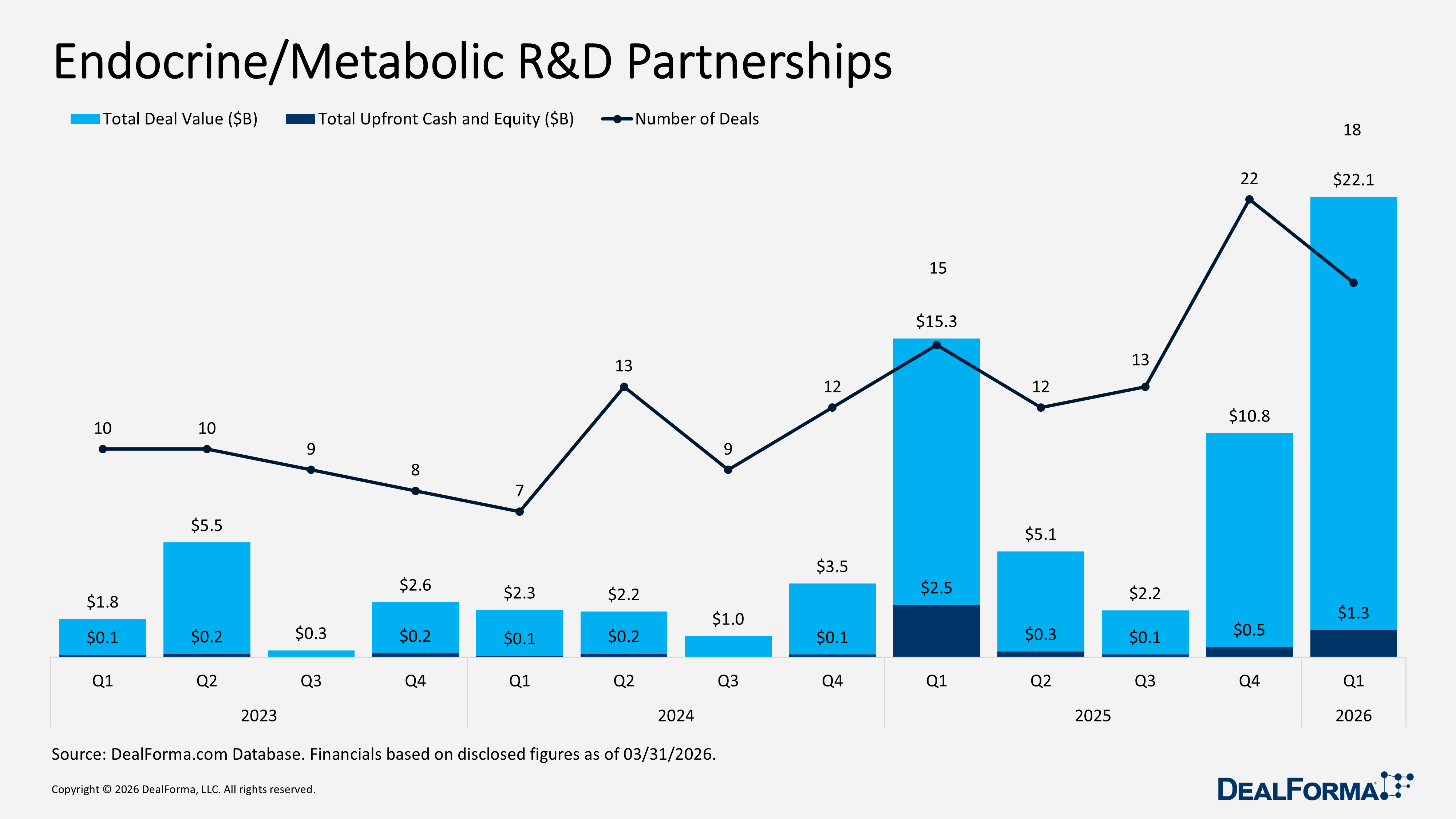
Endocrine/Metabolic R&D partnering in Q1 2026 was characterized by fewer but substantially larger transactions. Deal volume declined to 18 partnerships from 22 in Q4 2025, while total announced value more than doubled to $22.1 billion from $10.8 billion. Upfront cash and equity commitments also strengthened significantly, rising to $1.3 billion from $500 million. Average upfront consideration increased to $435 million from $62 million. Median upfront payments also improved from $35 million to $55 million. Across the two quarters, the sector recorded 40 partnerships with approximately $33 billion in total announced value and about $2 billion in upfront cash and equity.
Noticeable Endocrine/Metabolic R&D Partnerships in Q1 2026
CSPC Pharmaceutical development and commercialization deal with AstraZeneca – January 2026
CSPC Pharmaceutical granted AstraZeneca exclusive worldwide rights, excluding Greater China, to jointly discover, develop, and commercialize eight metabolic programs targeting obesity and type 2 diabetes. The collaboration includes one clinical-ready GLP-1R/GIPR agonist (SYH-2082), three preclinical programs, and four additional discovery-stage programs, leveraging CSPC’s AI-driven peptide discovery platform and proprietary once-monthly LiquidGel delivery technology. The agreement expands an existing strategic relationship between the companies, with AstraZeneca responsible for later-stage development and commercialization outside China. CSPC retains rights in Mainland China, Hong Kong, Macau, and Taiwan, while AstraZeneca holds an option to co-commercialize products in those markets. According to CSPC’s filing with the Hong Kong Stock Exchange, the agreement includes $1.2 billion upfront, with potential payments of up to $3.5 billion in development and regulatory milestones and up to $13.8 billion in commercial milestones, in addition to double-digit royalties.
Vivtex development and commercialization deal with Novo Nordisk – February 2026
Vivtex granted Novo Nordisk exclusive worldwide rights to develop and commercialize undisclosed oral therapies for obesity, diabetes, and related metabolic diseases using its proprietary drug-delivery technologies. The collaboration aims to address the longstanding challenge of poor gastrointestinal absorption that has limited the oral administration of peptide and protein therapies. By combining Vivtex’s AI-driven gastrointestinal screening and formulation platform with Novo Nordisk’s expertise in peptide and protein engineering, the partners seek to improve oral bioavailability and expand treatment options in metabolic disease. Under the agreement, Vivtex will lead research activities and formulation selection, while Novo Nordisk will be responsible for global development and commercialization. Vivtex is eligible to receive up to $2.1 billion in total consideration, including an upfront payment, research funding, and development and commercial milestones.
Nimbus development and commercialization deal with Eli Lilly – January 2026
Nimbus granted Eli Lilly exclusive worldwide rights to develop and commercialize an oral small molecule therapy for obesity and other metabolic diseases, building on their existing AMPK collaboration in cardiometabolic disease. The partnership integrates Nimbus’ AI-enabled computational chemistry and structure-based drug design capabilities with Eli Lilly’s expertise in metabolic disease drug development. Under the agreement, Nimbus is eligible to receive up to $55 million upfront and near-term milestone payments, with the detailed breakdown not disclosed. In addition, the company is eligible for up to $1.3 billion in development, commercial, and sales milestones, along with tiered royalties.
Endocrine/Metabolic Venture Activity
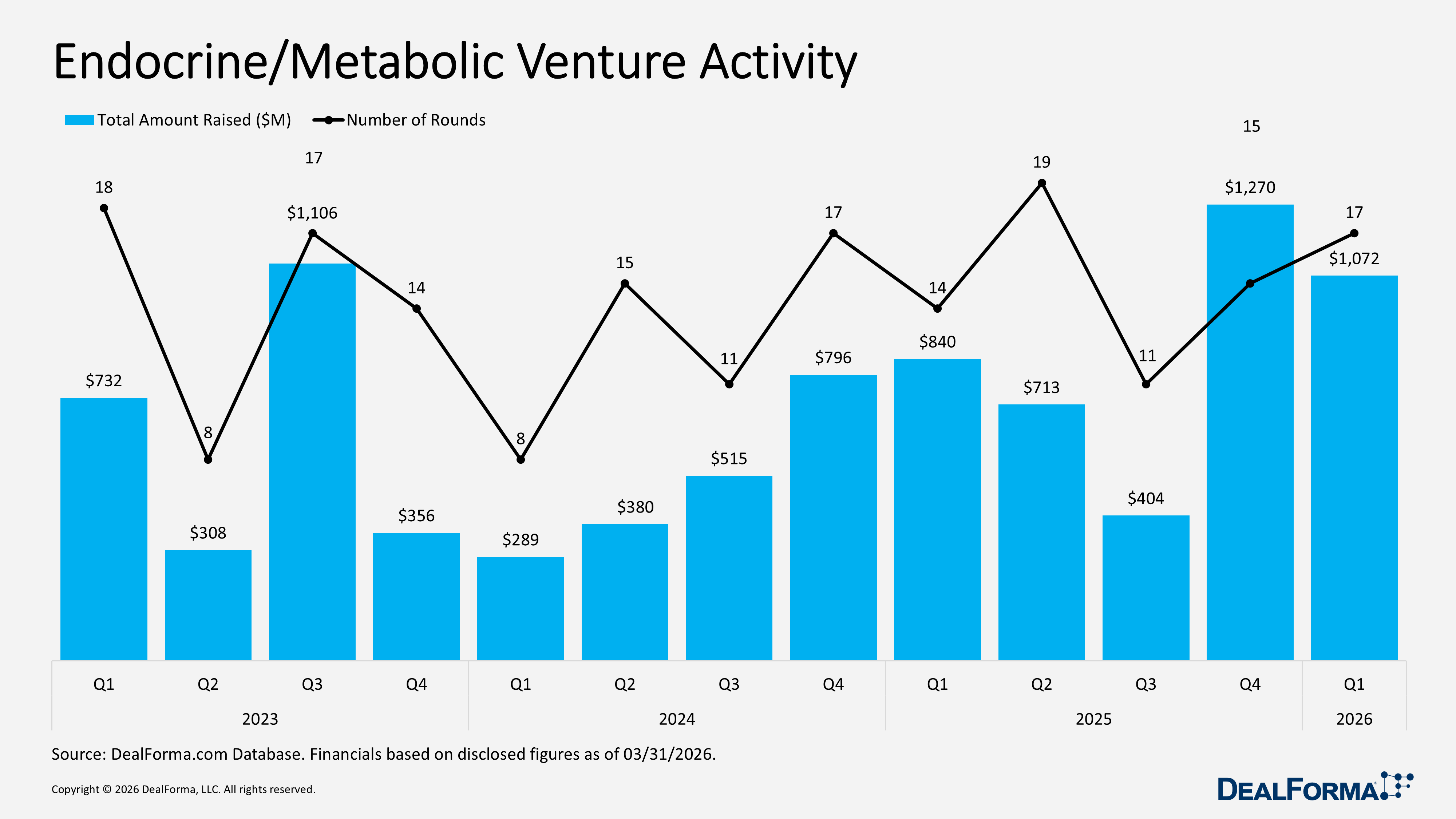
Endocrine/Metabolic venture funding remained active in Q1 2026, with deal volume increasing to 17 financing rounds from 15 in Q4 2025. However, total capital raised declined to $1.1 billion from $1.3 billion. Across the two quarters, Endocrine/Metabolic companies completed 32 venture financings and raised a combined $2.3 billion.
Noticeable Endocrine/Metabolic Venture Activity in Q1 2026
eMed – Series Unspecified – $200M – March 2026
eMed, a provider of AI-enabled obesity and weight management programs, raised $200 million in a series A financing in March 2026 at a valuation exceeding $2 billion. The company offers clinically managed GLP-1 programs, including Wegovy and Ozempic, supported by at-home testing and an AI-driven care platform. Proceeds will be used to expand its AI capabilities and launch a capitated, flat-fee model designed to help employers manage healthcare costs. The round was led by Aon Consulting, with participation from Tom Brady, Joe Lonsdale, Tom Ricketts, and CEO Linda Yaccarino. The financing highlights interest in obesity care delivery models, supported by reported 90% member adherence, average weight loss of 21 pounds, and improvement in at least one biomarker among 99% of participants within six months. In January 2026, Novo Nordisk recognized eMed as a care provider for the FDA-approved oral Wegovy pill, further validating its position in the growing obesity management market.
Alveus Therapeutics – Series A – $197M – January 2026
Alveus Therapeutics, focused on obesity and metabolic disease, emerged from stealth in January 2026 with a $159.8 million series A financing, which was expanded to an oversubscribed $197 million in a second and final close in February 2026. The company is developing therapies to deliver durable weight loss with improved tolerability and less frequent dosing than current treatments. Proceeds will support the clinical development of the lead candidate, ALV-100, a bifunctional GIP receptor antagonist and GLP-1 receptor agonist, as well as the advancement of additional pipeline programs. During the quarter, the FDA cleared the IND for ALV-100, and the first patient was dosed in a Phase 1b obesity study. The financing was led by New Rhein Healthcare Investors, Andera Partners, and Omega Funds, with participation from Sanofi Capital, Kurma Partners, Avego BioScience Capital, Jeito Capital, and Novo Holdings.
Ambrosia Biosciences – Series B – $100M – March 2026
Ambrosia Biosciences, focused on obesity and cardiometabolic disease, raised an oversubscribed $100 million series B financing in March 2026 to advance its oral small-molecule GLP-1 program into Phase 1 clinical trials and support development of its GIP and amylin pipeline. The lead candidate remains in IND-enabling studies and is designed as an oral alternative to injectable peptide therapies. The round was co-led by Blue Owl Healthcare Opportunities, Redmile, and Deep Track Capital, with participation from BVF Partners, Boulder Ventures, Janus Henderson Investors, Samsara BioCapital, and an undisclosed institutional investor.
Endocrine/Metabolic IPO Activity
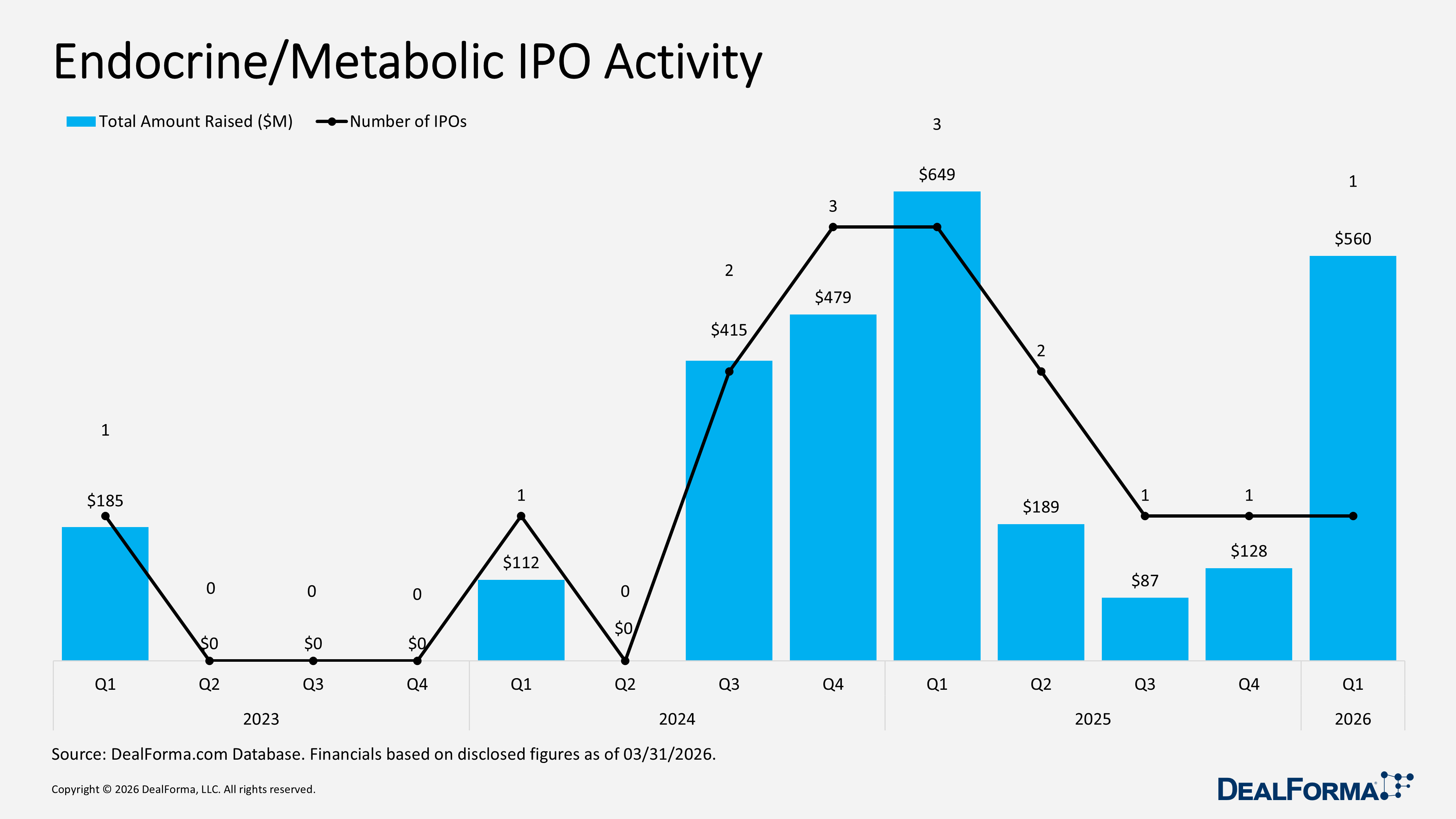
Endocrine/Metabolic IPO activity remained limited in Q1 2026, with 1 IPO completed, unchanged from Q4 2025. However, capital raised increased significantly to $560 million from $128 million, reflecting a substantially larger public offering. Across the two quarters, the sector recorded only 2 IPOs raising a combined $688 million.
Noticeable Endocrine/Metabolic IPO Activity in Q1 2026
MiniMed – IPO – $560M – March 2026
MiniMed, the diabetes device business spun out of Medtronic, raised $560 million in its March 2026 IPO through the sale of 28 million shares at $20 per share, implying a market value of approximately $5.6 billion. The company develops insulin pumps, continuous glucose monitors, and smart insulin pens for diabetes management. Net proceeds totaled roughly $538 million and will be used for general corporate purposes and repayment of intercompany debt to Medtronic, which retained about 90% ownership following the offering. For the six months ended October 24, MiniMed reported a $21 million net loss on $1.5 billion in revenue, compared with a $23 million loss on $1.3 billion in the prior-year period. Although the IPO priced below the marketed range of $25 to $28 per share and the stock traded below its offer price shortly after listing.
Also check out Cardiovascular R&D Partnerships, M&A and Venture Funding – Q1 2026 Review