During Q1 2026, neurology moved in dual directions. Partnerships and venture funding both cooled modestly, while M&A jumped sharply and became the clear engine of activity.
R&D Partnership deal volume slipped from 23 to 21, and total announced value fell more steeply from $8.6 billion to $3 billion as fewer agreements were signed. Upfront cash and equity held flat at $200 million. The average upfront rose from $39 million to $52 million while the median dropped from $36 million to $17 million, meaning a few large upfront commitments lifted the average even though most deals were smaller. The standout briefs reflect this: SciNeuro with Novartis ($165 million upfront, up to $1.5 billion in milestones) for Alzheimer’s antibodies, AriBio with Fosun Pharma (up to about $435 million) for oral Alzheimer’s drug AR-1001 across 10 ASEAN markets, and Rapport with Tenacia ($20 million upfront, up to $308 million) for epilepsy and bipolar mania asset RAP-219 in Greater China. Across both quarters, the segment recorded 44 deals worth $11.6 billion, with $400 million in upfront cash and equity.
M&A was the standout, strengthening sharply. Deal count rose from 19 to 21, but value expanded dramatically: total value, including contingents, jumped from $3.2 billion to $26.2 billion, and cash value, excluding contingents, rose from $2.9 billion to $24.2 billion. Deal sizes scaled up broadly, with average upfront cash and equity climbing from $590 million to $3.5 billion and the median from $200 million to $835 million, indicating the growth was spread across deals rather than driven by a single outlier. The highlighted prominent deals underscore the scale: Boston Scientific acquiring Penumbra ($14.5 billion enterprise value) in neurovascular devices, Eli Lilly acquiring Centessa (about $6.3 billion upfront plus up to $1.5 billion in milestones) for sleep disorder assets, and Otsuka acquiring Transcend (up to $1.2 billion) for a PTSD neuroplastogen. Over both quarters, M&A totaled 40 deals worth $29.4 billion, including contingents, or $27.1 billion in cash value.
Venture funding eased slightly but stayed strong. Financing rounds fell from 45 to 40, and total capital raised edged down from $2.1 billion to $2 billion, a modest slowdown. The largest rounds came from companies adjacent to neurology in digital and mental health: WHOOP ($575 million series G, $10.1 billion valuation) in wearable health, Talkiatry ($210 million series D) in virtual psychiatry, and Grow Therapy ($150 million series D, about $3 billion valuation) in mental health access. Across both quarters, the sector logged 85 rounds and $4.1 billion in total funding.
Neurology R&D Partnerships
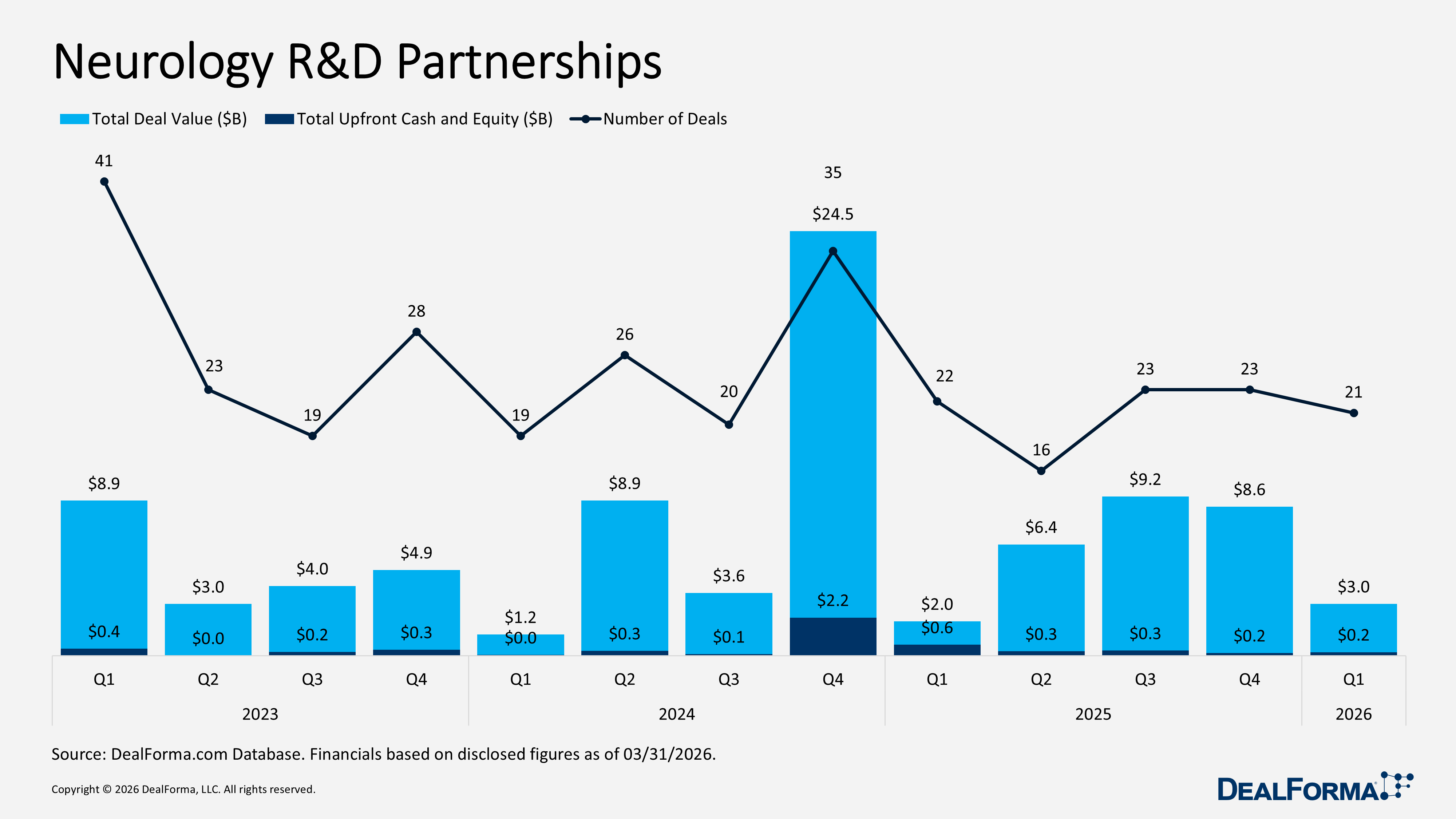
Neurology R&D partnership activity moderated in Q1 2026 compared with Q4 2025. Deal volume declined from 23 to 21 transactions, while total announced value fell more sharply from $8.6 billion to $3 billion, reflecting fewer large-scale agreements. Total upfront cash and equity remained unchanged at $200 million in both quarters. However, the average upfront payment increased from $39 million to $52 million, while the median declined from $36 million to $17 million. Across the two quarters, Neurology R&D partnerships totaled 44 deals with an aggregate value of $11.6 billion and $400 million in upfront cash and equity.
Prominent Neurology R&D Partnerships in Q1 2026
SciNeuro development and commercialization deal with Novartis – January 2026
SciNeuro entered a global licensing agreement with Novartis, granting exclusive worldwide rights to develop and commercialize amyloid beta-targeted antibodies for Alzheimer’s disease using SciNeuro’s blood-brain barrier shuttle technology. The companies will jointly support early-stage development, after which Novartis will assume full responsibility for development and commercialization. The deal provides SciNeuro with $165 million upfront and the potential to receive undisclosed research funding and up to $1.5 billion in development, regulatory, and commercial milestone payments, in addition to tiered royalties.
AriBio development and commercialization deal with Fosun Pharma – January 2026
AriBio entered into an exclusive licensing agreement with Fosun Pharma, granting rights to develop and commercialize its oral small molecule AR-1001 for Alzheimer’s disease (AD), a neurologic indication, across 10 ASEAN markets, including Singapore, Indonesia, the Philippines, Thailand, Vietnam, Cambodia, Laos, Malaysia, Myanmar, and Brunei. AR-1001 is currently in Phase III clinical development, with topline data expected in the first half of 2026. Under the agreement, Fosun Pharma will assume responsibility for manufacturing, regulatory approvals, and full commercialization in the licensed territories. AriBio is eligible to receive up to KRW 630 billion (approx. $435 million) in total consideration, including upfront payment and development, regulatory, and commercial milestones.
Rapport development and commercialization deal with Tenacia Biotechnology – March 2026
Rapport granted Tenacia Biotechnology exclusive rights to develop and commercialize RAP-219 in Greater China, including mainland China, Hong Kong, Macau, and Taiwan. RAP-219 is a Phase II TARPγ8-specific AMPA receptor negative allosteric modulator being developed for neurological disorders, including focal onset seizures, primary generalized tonic clonic seizures, and bipolar disorder (mania). Rapport will retain rights to RAP-219 in all other global territories. Under the agreement, Rapport will receive $20 million upfront and is eligible for up to $308 million in development and commercialization milestones and other payments, with individual breakouts not disclosed.
Neurology M&A
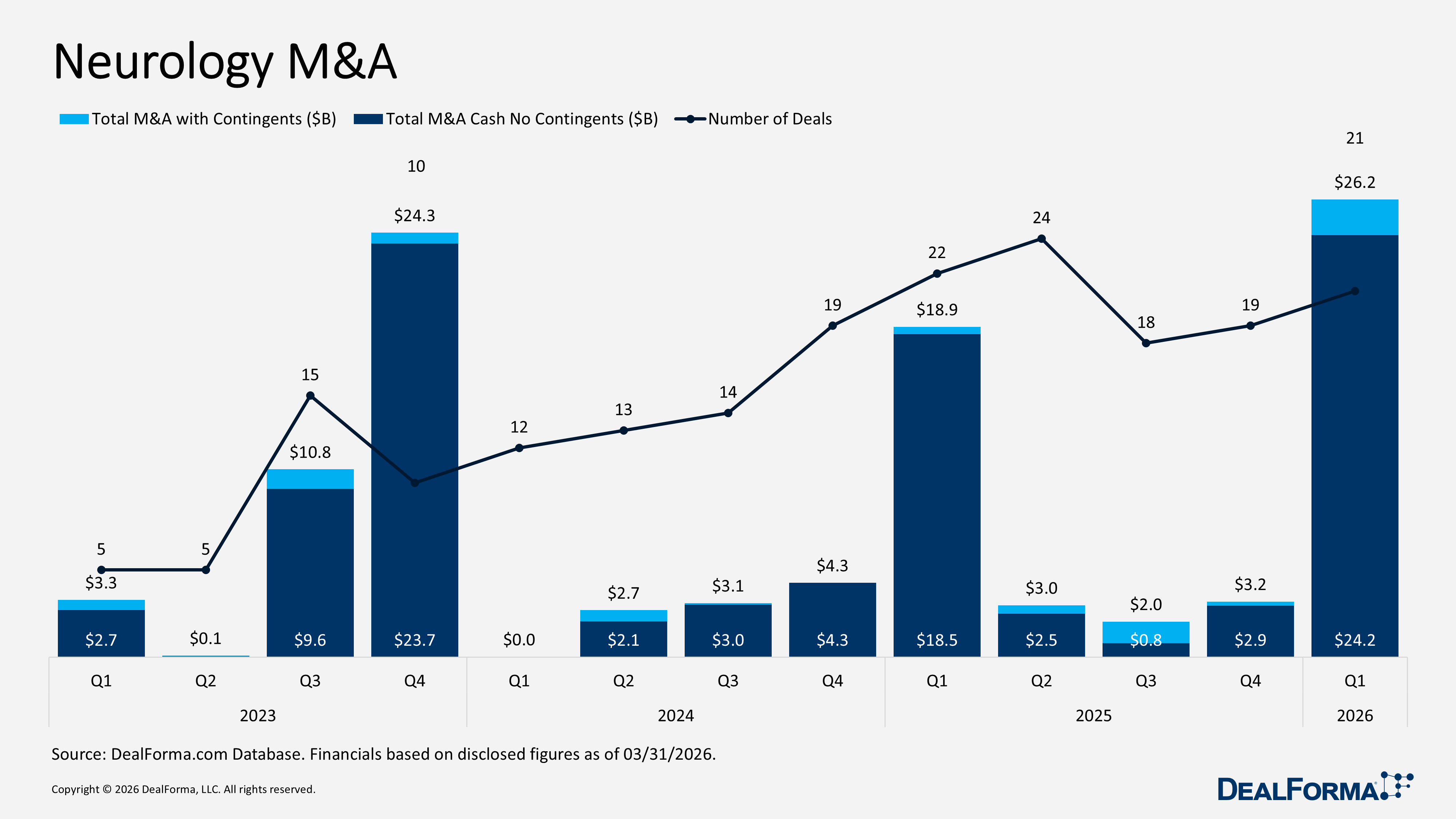
Neurology M&A activity strengthened markedly in Q1 2026 compared with Q4 2025. Deal volume increased from 19 to 21 transactions, while total deal value, including contingents, surged from $3.2 billion to $26.2 billion. Total cash value excluding contingents also rose significantly, from $2.9 billion to $24.2 billion, reflecting a substantial increase in transaction scale during the quarter. Deal sizes expanded considerably, with average upfront cash and equity increasing from $590 million to $3.5 billion and the median rising from $200 million to $835 million. Across the two quarters, Neurology M&A activity totaled 40 deals worth $29.4 billion, including contingents and $27.1 billion in cash value excluding contingents.
Prominent Neurology M&A in Q1 2026
Boston Scientific acquiring Penumbra – January 2026
Boston Scientific agreed to acquire Penumbra in a transaction spanning device asset across the neurovascular and peripheral vascular markets. Penumbra’s lead portfolio includes FDA-approved neuro and peripheral vascular medical devices. Neurovascular products include the ACCESS25 delivery microcatheter, ARTEMIS neuro evacuation device, BMX81 and BMX96 access systems, and ACE reperfusion catheters, while peripheral vascular offerings include the Indigo system, CAT RX, Lightning Flash 2.0, and Lightning Bolt 12. The transaction is expected to close in 2026, subject to customary regulatory approvals, after which Penumbra will be delisted from the NYSE. The deal strengthens Boston Scientific’s position in mechanical thrombectomy and neurovascular markets and expands its broader cardiovascular and peripheral vascular portfolio. Penumbra shareholders may elect to receive $374 in cash or 3.8721 shares of Boston Scientific stock, representing a 19.3% premium and an enterprise value of $14.5 billion. The consideration mix is subject to Article-II of the merger agreement, consisting of 73.26% cash and 26.74% stock. Stock option holders and accelerated RSUs will vest and convert into $274 in cash plus 1.0353 Boston Scientific shares.
Eli Lilly acquiring Centessa Pharmaceuticals – March 2026
Eli Lilly agreed to acquire Centessa Pharmaceuticals, with the transaction expected to close in 3Q 2026. Centessa’s lead asset is Phase II cleminorexton (formerly ORX-750), being developed for narcolepsy type I and type II as well as idiopathic hypersomnia. The pipeline also includes Phase I ORX-142 for neurological and neurodegenerative disorders, and preclinical ORX-489 for neuropsychiatric disorders. Under the terms of the agreement, Centessa shareholders will receive $38 in cash per share, representing approximately $6.3 billion upfront consideration, reflecting a one-day premium of approximately 37.8% and a premium of approximately 40.5% to the 30-day volume weighted average price. Shareholders are also eligible for one non-transferable Contingent Value Right (CVR) worth up to $9 per share, representing up to $1.5 billion in additional value upon achievement of specified milestones. The CVR structure includes three potential payments. i) $2 per CVR upon FDA approval of cleminorexton or ORX142 for narcolepsy type 2 within 5 years, ii) $5 per CVR upon FDA approval of cleminorexton for idiopathic hypersomnia within 5 years, and iii) $2 per CVR upon the first FDA approval of cleminorexton for any other indication before January 1, 2030.
Otsuka Pharmaceutical acquiring Transcend Therapeutics – March 2026
Otsuka Pharmaceutical, through its US subsidiary Otsuka America, agreed to acquire Transcend Therapeutics in a transaction expected to close in Q2 2026. Transcend’s lead asset is TSND-201 (methylone), a non-hallucinogenic, rapid-acting neuroplastogen that enhances neuroplasticity via monoamine modulation. The asset is currently in Phase III development for post-traumatic stress disorder and in Phase II for generalized anxiety disorder (GAD) and major depressive disorder (MDD) and has received Breakthrough Therapy Designation (BTD) from the US FDA. The acquisition is intended to strengthen Otsuka’s psychiatry and neurologic pipeline and accelerate the development of next-generation neuropsychiatric therapies. Under the terms of the agreement, transcend shareholders will receive $700 million upfront in cash and are eligible for up to $525 million in commercial milestones, bringing the total potential deal value to up to $1.2 billion.
Neurology Venture Activity
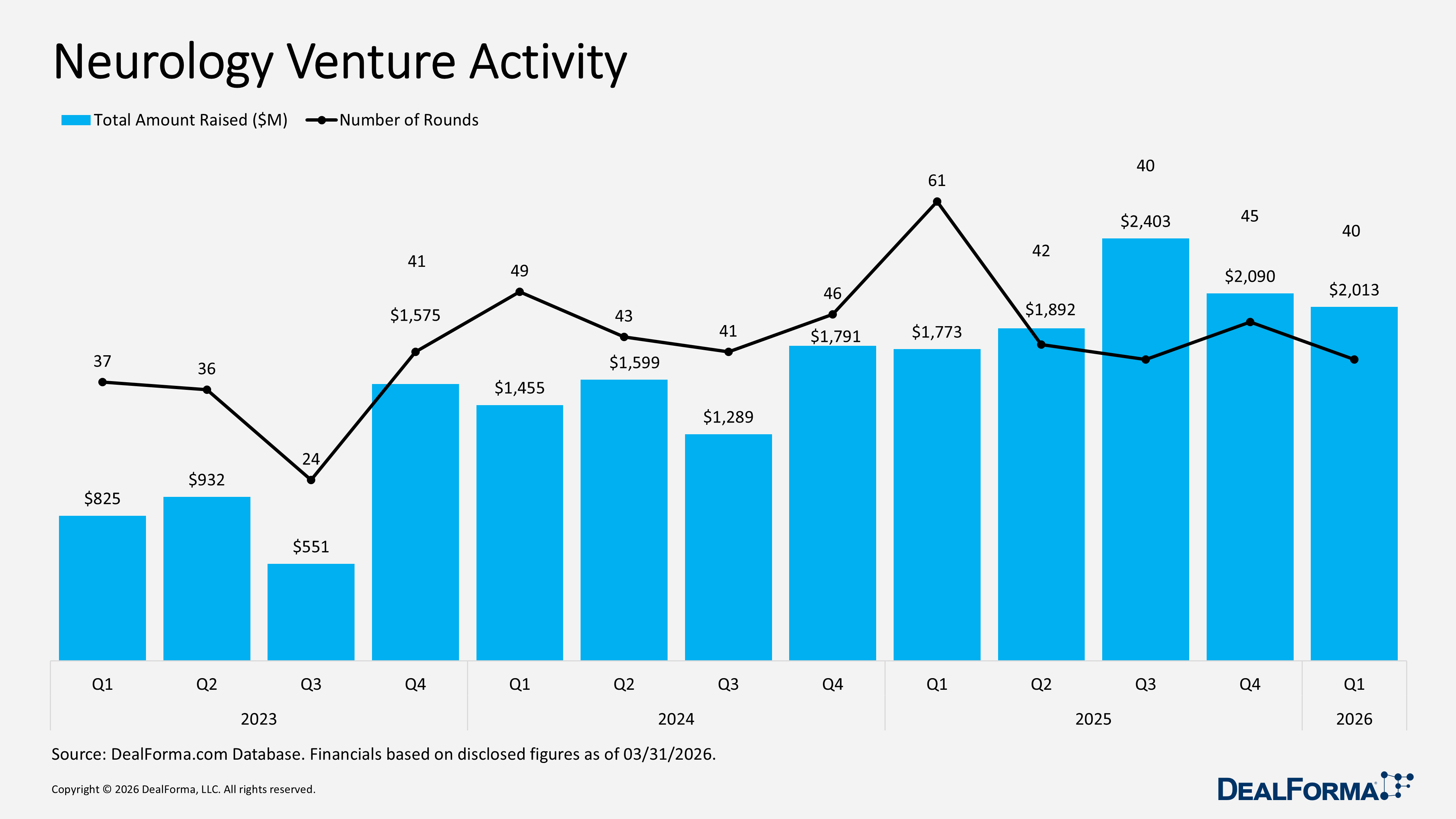
Neurology venture funding moderated slightly in Q1 2026 compared with Q4 2025. The number of financing rounds declined from 45 to 40, while total capital raised edged down from $2.1 billion to $2 billion, indicating a modest slowdown in activity. Despite the quarter-over-quarter decline, funding levels remained robust. Across the two quarters, the sector recorded 85 financing rounds and $4.1 billion in total funding.
Prominent Neurology Venture Activity in Q1 2026
WHOOP – Series G – $575M – March 2026
WHOOP raised $575 million in a series G financing announced in March 2026, valuing the company at $10.1 billion. The company develops a subscription-based wearable health and fitness platform that combines continuous physiological monitoring with AI-driven insights on sleep, exercise, recovery, and early health risk detection. While not focused on a specific neurologic indication, WHOOP operates at the intersection of digital health, preventive care, and human performance. The financing represents a significant increase from the company’s $3.6 billion valuation in August 2021 and brings total capital raised since 2012 to more than $900 million. Proceeds will support continued growth in the United States and expansion across Europe, the Gulf region, Latin America, and Asia. The round was led by Collaborative Fund and included participation from Abbott, Mayo Clinic, Qatar Investment Authority, Mubadala, 2PointZero Group, Macquarie Capital, IVP, Foundry, Accomplice, Affinity Partners, Glade Brook, B-Flexion, Promus Ventures, Bullhound Capital, and several high-profile athlete investors.
Talkiatry – Series D – $210M – February 2026
Talkiatry raised $210 million in series D financing in February 2026, bringing total capital raised to more than $400 million. The company operates a virtual psychiatry platform that directly employs psychiatrists and provides medication management and mental health services for conditions including anxiety, depression, attention-deficit/hyperactivity disorder (ADHD), bipolar disorder, mood disorders, and post-traumatic stress disorder. Talkiatry noted revenue growth of 1,745% between 2021 and 2024. Proceeds will support clinician recruitment, technology development, and expansion into more complex care services. The financing was led by Perceptive Advisors, with participation from Sofina, Andreessen Horowitz (a16z), blisce/, Left Lane Capital, and Banc of California through a debt facility. The company’s scale remains a key differentiator, with more than 800 full-time psychiatrists, three million patient visits completed, and in-network coverage across more than 100 insurers reaching over 170 million lives.
Grow Therapy – Series D – $150M – March 2026
Grow Therapy secured $150 million in series D financing in March 2026, increasing total capital raised to $328 million. The company operates a mental health platform that connects patients with licensed therapists and psychiatrists through both in-person and virtual care, working closely with insurers, employers, and health systems to improve access to behavioral healthcare services. The company reported approximately $1 billion in revenue, with an estimated valuation at roughly $3 billion. Funding will be used to expand in-person and virtual care offerings, enhance technology capabilities, and deepen relationships with employers and health systems. The round was led by existing investors TCV and Growth Equity at Goldman Sachs Alternatives, with new participation from BCI and Menlo Ventures alongside Sequoia, SignalFire, and Transformation Capital. Grow Therapy’s scale and distribution footprint remain central investment drivers, supported by a network of 26,000 providers and health plan access reaching approximately 220 million Americans.
Also check out Cancer R&D Partnerships, M&A, Venture Funding and IPO Activity – Q1 2026 Review